

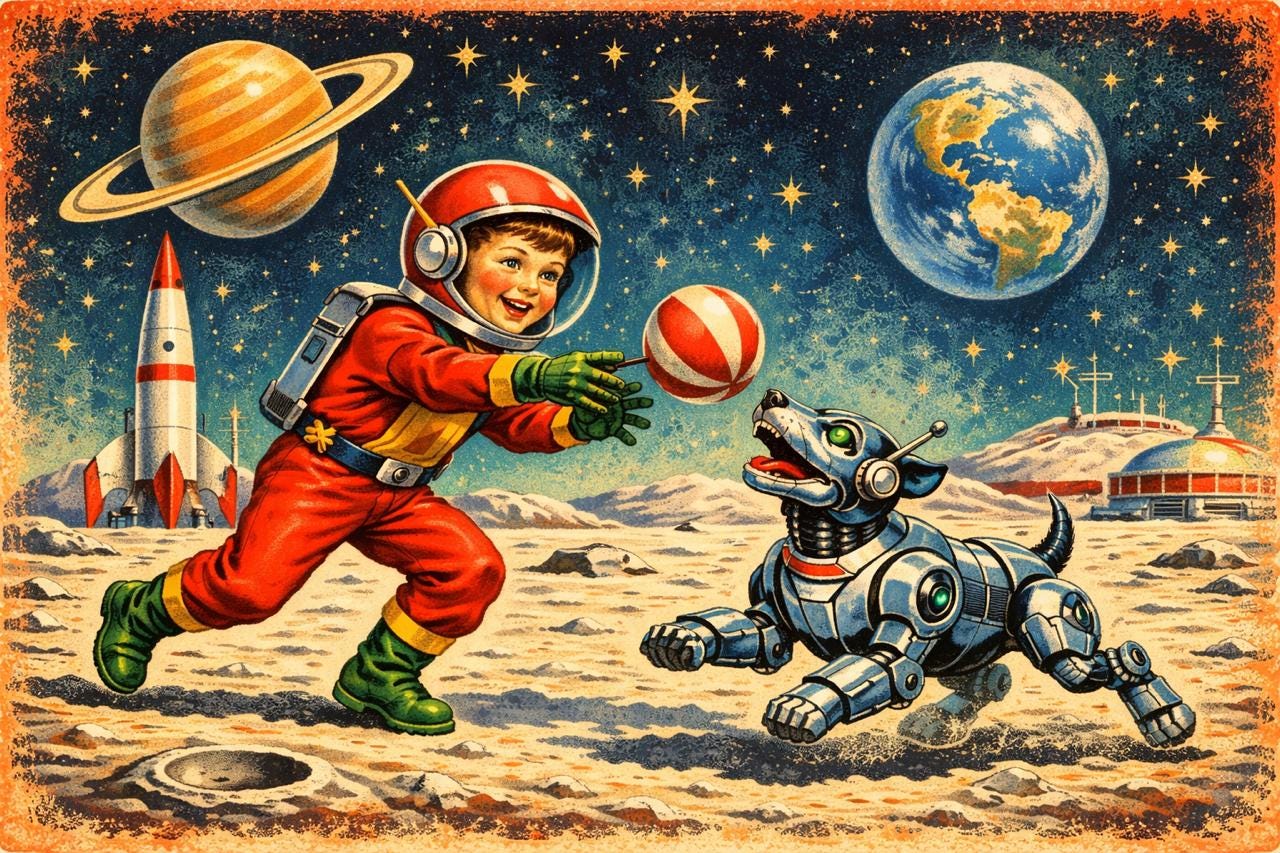
“What will the difference be between the Robutt and the dog?” This was the question that little Jimmy asked his father, Mr. Anderson, when he decided to replace his beloved positronic-robot dog, Robutt, with a real dog. Mr. Anderson answered his little boy’s question in three sentences and said “It’s hard to explain, but it will be easy to see. The dog will really love you. Robutt is just adjusted to act as thought it loves you” Little Jimmy, unsatisfied with his father’s answer, questioned him with genuine skepticism, asking; “But, Dad, we don’t know what’s inside the dog, or what his feelings are. Maybe it’s just acting, too.”
In the grand tapestry of time, as we gaze upon the tale Asimov crafted over half a century ago, it becomes a noble quest to ponder the profound wisdom Mr. Anderson bestowed upon his son; “Jimmy, you’ll know the difference when you experience the love of a living thing”. We must all embrace the bewilderment and the anxiety that little Jimmy experienced in the tale, perhaps not concerning the substitution of our cherished Robutt, but in rediscovering to confront the truth before succumbing to the fabricated tale, the art of forging epistemic creations independently, and possessing our own truths.
When Gatekeepers of the Truth Turns into Dealers of Dopamine Junkies
In the wake of the U.S. declaration of military strikes against Venezuela, a storm of AI-generated images and deceptive videos depicting Nicolás Maduro’s “capture” surged across the digital landscape. These false narratives were rapidly magnified by influencers and officials, weaving a fast-moving misinformation fog that enveloped audiences and decision-makers at a moment of heightened vulnerability, threatening to obscure the truth and sow chaos. The true controversy lies not in the fate of Nicolás Maduro or the hidden events, but in the mysterious allure that compels people to embrace and propagate these fabricated tales and imagery. Propagators can be seen as warriors of influence, wielding their power with either noble intentions, like seeking fortune through the clicks of the masses, or with shady motives, aiming to sway the crowd to their hidden agenda. Real curiosity lies in the crowd who chose to embrace those lies. Are they genuinely lost their reason, or did they intentionally become dopamine junkies?
The Enigma of What Dopamine Truly Supplants Remains a Monumental Puzzle
May it be the curiosity? In the realm of digital realms, where dopamine reigns supreme, the quest for knowledge is often thwarted by the siren call of instant gratification. This relentless pursuit of fleeting pleasures eclipses the pursuit of curiosity, which thrives on the fertile ground of uncertainty, patience, and a brave embrace of ambiguity. Curiosity, the ancient muse of discovery, demands the courage to delay gratification, to linger in the shadows of the unknown, and to embark on the epic journey of inquiry. Yet, in this age of rapid consumption, the spark of curiosity is extinguished before it can ignite the flame of understanding.
May it be the truth-seeking? In the grand saga of human cognition, dopamine emerges as a formidable force, not merely diverting the seeker from the path of truth, but transforming the very essence of how truth is discerned. In the realms of understanding, truth was a noble quest, judged by its alignment with the immutable reality, its harmony with the tapestry of existing knowledge, and its resilience to the trials of verification and falsifiability. Yet, in the modern epoch of the dopamine economy, truth is redefined by the symphony of emotional resonance, the allure of narrative satisfaction, the vibrancy of social connection, and the validation of pre-existing affective states. Thus, the journey of truth-seeking is forever altered, as the criteria shift from the cold, hard facts to the warm, inviting embrace of human experience.
May it be the moral responsibility? In the chronicle of knowledge consumption, moral responsibility stands as a mighty guardian, demanding that we recognize the weight of our beliefs. Yet, in the realm of dopamine-driven epistemology, this guardian is cast aside, transforming the quest for truth into a mere spectacle of entertainment. When misinformation is devoured for its allure, belief becomes a fleeting whisper, commitment a mere suggestion, and responsibility a shadow dispersed across the land. The seeker no longer inquires, “Is this true?” but instead, “Is this captivating?”
I MEAN, Do We Have to Make Them Dispose the Robutt?
Maybe we are not yet advanced enough to create positronic-robots, but our technology is advanced enough to create fake imagery, construct false narratives, and distribute them all across the globe in a blink of an eye. More importantly, we are lucky(?) enough to find a crowd to embrace all of our hard-work(!). Yet, in all of this success, there’s a shadow of doubt… Are we truly lucky, or have we just stumbled onto a dangerous path? Should it be our noble quest to make our crowd realize the intrinsic value of the difference between reality and creation? Is it really matter for them to realize, or is it really matter for us to if they realize? Do we have to make them dispose the Robutt when they are just doing fine with him? But above all, can we brace ourselves for the moment they choose to retain the Robutt..?
