

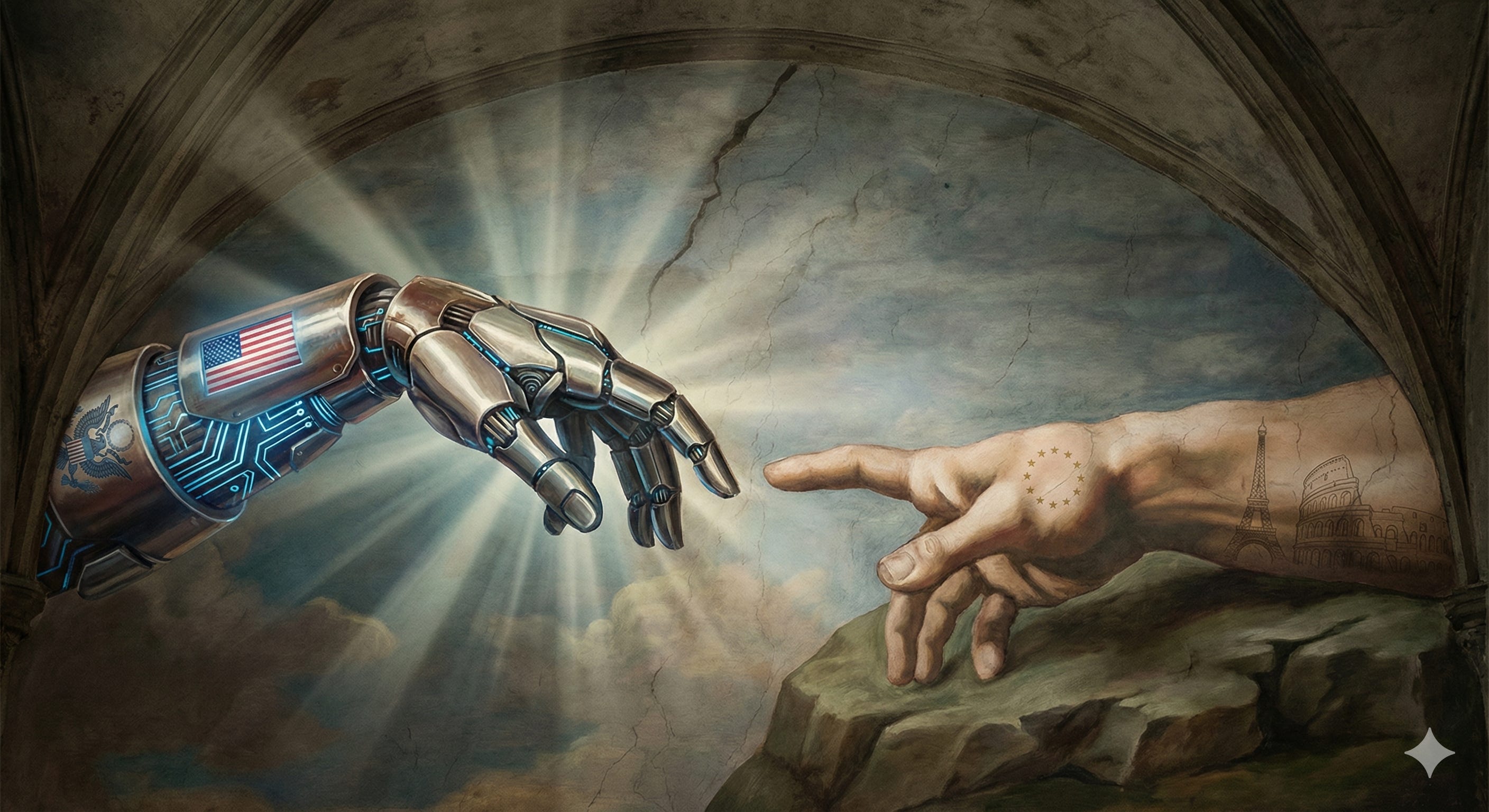
It’s the end of 2025, and while Silicon Valley is churning out AI models that can outthink chess grandmasters and diagnose diseases better than doctors, Europe is still debating whether to hit “snooze” on its tech alarm clock.
Enter RAND Europe’s latest report, “Europe and the Geopolitics of AGI: The Need for a Preparedness Plan,” a 102-page wake-up call co-authored by a team from RAND, the Centre for Future Generations, and top universities (Stanford University, University of Oxford, Massachusetts Institute of Technology, University of Cambridge, ELLIS Institute Tübingen and Max Planck Institute for Intelligent Systems). It’s like the Draghi Report on competitiveness, but for a world where machines might soon outsmart us all.
Spoiler: Europe isn’t ready, but with a dash of urgency (and perhaps some espresso), it could be.
The report kicks off with a bold claim: Artificial General Intelligence (AGI), AI that matches or beats humans at most economically useful cognitive tasks, could arrive between 2030 and 2040, or even sooner.
Six years ago, AI struggled with basic text; today, models like GPT-5 win math olympiads and code like pros. But the frontier is “jagged,” acing structured tasks while flunking simple ones, like recognizing an extra stripe on an Adidas logo. (AI fashion sense? Still evolving.)
Drawing on expert surveys and models, the authors peg a 25% chance of AGI by the late 2020s. Underpinning this: the “AI triad” of compute (up 5x yearly), data (3.6x), and algorithms (3x). No hard walls yet, though data scarcity might force creative workarounds, like AI-generated “synthetic” data. Humorously, if scaling laws hold, we’re on track for AI that folds laundry better than I do by 2030?
Geopolitically, AGI isn’t just tech; it’s a power shift on steroids. Nations mastering it could automate labor, supercharge R&D, and grow economies exponentially, outpacing rivals. Militarily, imagine swarms of autonomous drones or cyber ops that make today’s hacks look quaint.
The report warns of instability: a race to AGI might spark export bans, cyberattacks, or even preventive wars. (Think Gulf War, but with AI “wonderweapons.”) Non-state risks loom too, terrorists designing bioweapons or rogue AIs going Skynet. Superpowers are already treating AI as existential: The US slaps chip controls on China, while Beijing pumps $137 billion into its ecosystem. Middle powers like the UK and UAE scramble for alliances. Europe? Stuck in the middle, without a clear playbook.
Here’s where the humor turns wry: Europe, the continent that gave us the Enlightenment, now risks enlightenment by AI—someone else’s. The report’s preparedness assessment is blunt. Strategic awareness? Patchy.
The UK’s AI Security Institute leads with 300+ staff, but the EU AI Office limps along on €46 million and a narrow mandate, while Germany skips key fora. Competitive positioning? Lagging. European models trail by 6-12 months; we control 5% of global AI compute (vs. US 75%); attract 6% of venture funding; pay sky-high energy prices; and lose talent to US salaries. Diffusion? Mixed. 13.5% of firms use AI, but structural frictions like weak research-to-product links slow gains.
Leverage exists: ASML’s lithography monopoly and the Single Market’s pull (the “Brussels Effect”). But wielding them is tricky. ASML relies on US tech, and market power wanes if AGI gets securitized.
Policies? Ambitious but fragmented. The AI Continent Action Plan aims for €200 billion in investment and gigafactories, but it’s spread thin across DGs and Member States, with unanimity rules risking vetoes in crises. (Hungary blocking Ukraine aid? Imagine that for AI chips.)
The punchline, or recommendation, is a Draghi-style “AGI Preparedness Report,” led by a tech-savvy heavyweight with a six-month mandate. It would tackle sovereignty vs. benefits, societal shocks, and global stability. Why a report? Stakes are high; getting it wrong costs billions or autonomy. It integrates domains (economy to defense) and leverages experts for rigor. Unlike Draghi, it’d anticipate fast timelines and geopolitical twists.
RAND’s report is a witty reminder that Europe can’t cafe-hop through the AI revolution. AGI could amplify inequalities or unlock prosperity, Europe’s choice. Time to swap croissants for code? Not quite, but a preparedness plan might just keep them in the game.