


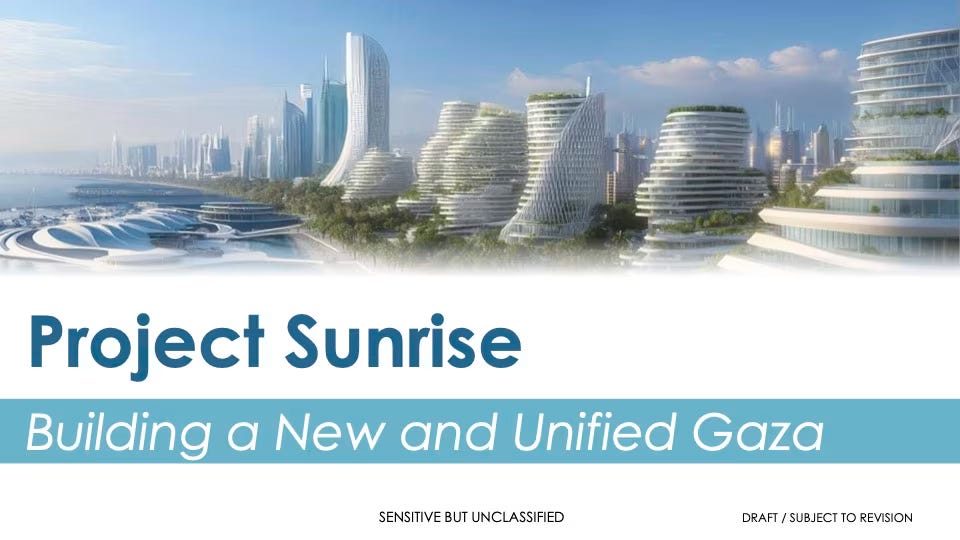
Picture this: One day, you’re scrolling through headlines about endless conflict in Gaza. The next, a glossy PowerPoint leaks, 32 slides of gleaming beachfront high-rises, high-speed rail slicing through palm-lined boulevards, AI humming in smart grids that optimize everything from traffic to trash collection. Luxury resorts dot the coast, turning what was once a war zone into the “Riviera of the Middle East.” It’s called Project Sunrise, a $112 billion, decade-long vision pitched by none other than Jared Kushner and Steve Witkoff, Trump’s inner circle real estate wizards.
But hold up! This isn’t just another postwar rebuild. This feels like something straight out of Silicon Valley’s wildest fever dreams. Because while Kushner and crew are hawking this to Gulf donors and governments, a parallel movement in tech circles is plotting to bypass nation-states altogether: the Network State.
The Sunrise Pitch: From Ashes to AI-Powered Paradise
Let’s zoom in on the plan itself. Project Sunrise, a slick 32-slide PowerPoint dreaming up a $112 billion transformation over ten years. The vision? Turn Gaza’s coastline into a high-tech enclave. Gleaming high-rises, luxury resorts, high-speed rail, AI-optimized smart grids managing everything efficiently.
But here’s the stark reality check. You don’t get to this glossy future without confronting how we got here. Gaza lies in ruins. 68 million tons of rubble, toxic soil contaminated by explosives, unexploded ordnance scattered everywhere, thousands still buried beneath the debris.
Phase one isn’t magic, it’s grim. Clear the mountains of destruction, detox the ground, recover bodies. Temporary shelters for 2 million people? The details are conveniently fuzzy where exactly do they go, and for how long?
At the helm is Jared Kushner, the real estate developer turned Middle East dealmaker, whose Affinity Partners is flush with billions from Gulf sovereign funds. He’s long described Gaza’s coastline as “very valuable waterfront property”, words that landed controversially amid the crisis, sounding to many like eyeing a fire sale. Trump dubs it the “Riviera of the Middle East,” pitching it to donors in Miami meetings.
The renders are seductive, no doubt that futuristic coastal paradise rising from a “blank canvas.” But that canvas wasn’t blank to begin with; it was home to millions, with beaches and neighborhoods that existed long before the devastation.
Critics see disaster opportunism. A war-torn enclave reimagined as an elite playground, with displacement risks baked in, funding uncertainties, and a heavy reliance on external capital. Who benefits most from those projected billions? The residents, or the investors circling the waterfront?
It’s a bold pitch, sure. But against the backdrop of utter ruin, it raises uncomfortable questions about whose sunrise this really is.
Meanwhile, in Silicon Valley: Building Nations from Scratch
Cut to the tech elite, who’ve grown tired of pesky regulations, taxes, and democracies slowing their roll. Enter the Network State, popularized by Balaji Srinivasan in his 2022 book The Network State: How To Start a New Country. Start online with a highly aligned community (crypto bros, longevity hackers, whatever your tribe). Crowdfund, build digital tools, then “land” on physical soil.

Key players? Balaji himself, Peter Thiel, Vitalik Buterin (Ethereum powering blockchain governance), Bryan Johnson (anti-aging guru). Projects like Próspera in Honduras (Thiel-backed, company-run zone facing lawsuits), Praxis (mega-funded crypto city hunts), Zuzalu pop-ups. Conferences in Singapore draw governments from Dubai to El Salvador.
It’s “exit” over “voice”. Don’t vote to change the system, just leave and build your own. Neoliberal utopia: Custom rules, blockchain votes, opt-in societies. Critics call it techno-colonialism—elites grabbing land in weaker nations, deepening inequality.
The Eerie Overlaps: Same Vibes, Different Pitch Decks?
No emails showing Balaji whispering in Kushner’s ear, or Thiel cutting checks for Project Sunrise. But the parallels? Uncanny.
Both crave autonomous zones. Low-tax, custom-governed enclaves on “undervalued” land. Gaza post-conflict? A devastated tabula rasa, perfect for special economic treatment. AI/smart tech central to both. Network States love blockchain governance, Sunrise touts AI grids and innovation labs.
Ideology echoes. Disaster as opportunity. Kushner’s old comments on Gaza’s beachfront value mirror how Network State fans eye “blank slates” (failed states, empty lands). Charter cities like Próspera are the prototype, private management, “exit” freedom.
What if Gaza becomes the biggest test yet? Gulf cash (already funding Kushner) meets U.S. muscle, turning it into a de facto Network node; crypto-friendly, tech-elite haven, loosely tied to hosts but running its own show.
Utopia or Dystopian Land Grab?
Optimists say “Boom time! Jobs, prosperity, peace through shiny infrastructure. A model for conflict zones worldwide.”
Pessimists say “Colonialism 2.0. Displacement risks (voluntary? Sure.), inequality baked in (who gets the penthouses?), fragility to hacks or backlash. Žižek-style critique: Elites escaping democracy, allying with autocrats.
Is Gaza the unwitting pilot for the Network State dream. Trump real estate meets Valley disruption? Or just ambitious rebuilding with familiar flaws?
One thing’s clear: In this hyper-connected world, borders are blurring. Whether it’s Sunrise rising or a networked experiment landing, the future of sovereignty just got a lot more intriguing. Buckle up. this story’s just starting.