

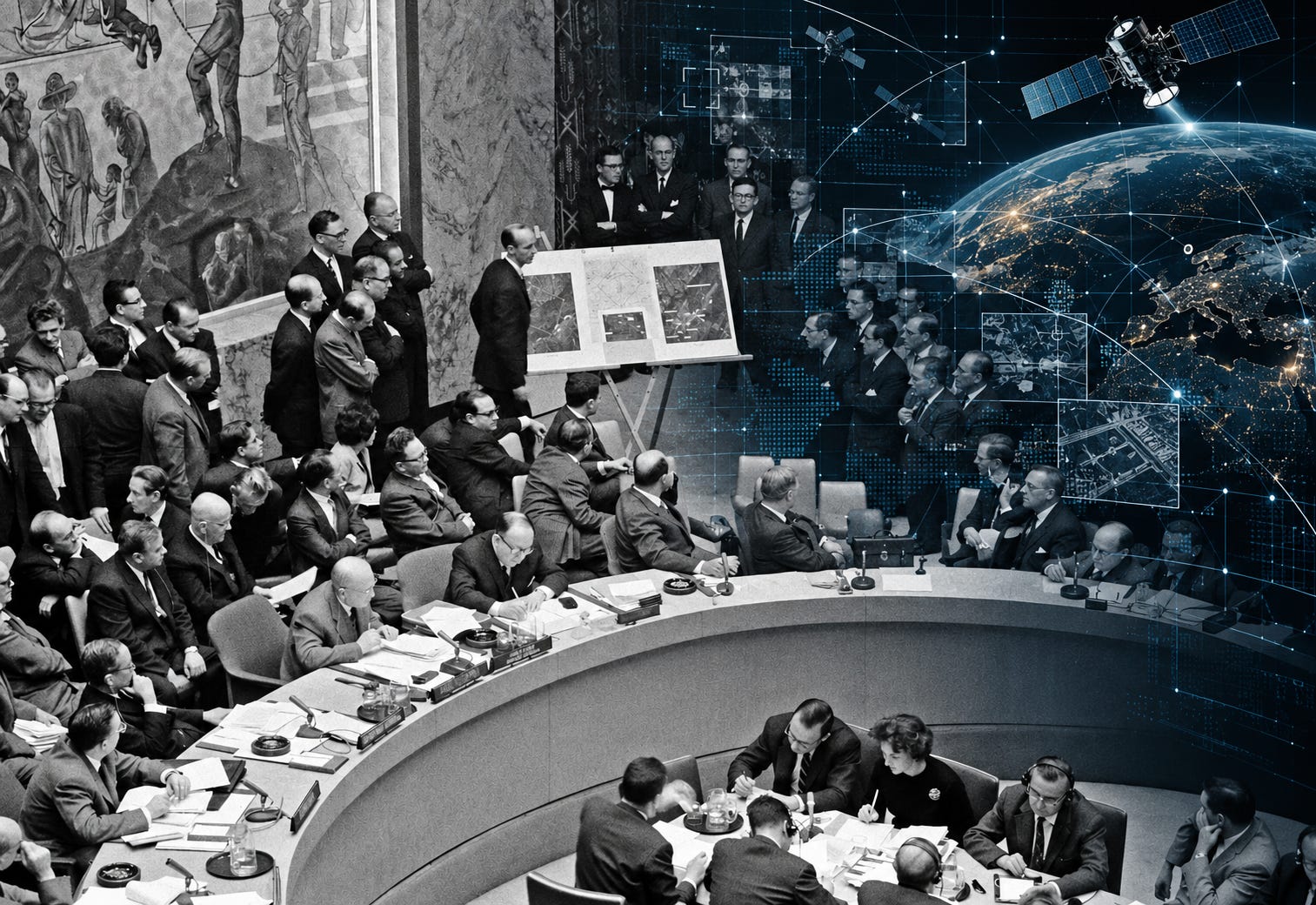
George Kennan’s 1946 “Long Telegram” described a world of states, competing ideologies, and territorial spheres of influence. Kenneth Waltz’s 1979 Theory of International Politics centered structural realism on states under anarchy. Francis Fukuyama’s “end of history” thesis assumed decisive struggles would occur among states and regimes.
By 2026, the landscape has changed. Palantir, Starlink, Nvidia, OpenAI, and ByteDance now generate strategic effects that rival or exceed those of many states. They shape conflicts, control critical data flows, and set the terms of technological competition between major powers. International relations scholarship still speaks fluently of polarity, institutions, and norms, yet it has thinner language for power rooted in sensors, models, and the ability to shape what others can know.
Earlier theories were not false in their time. They explained state behavior within a particular technological and institutional setting. That setting has been transformed. Power now moves through data infrastructures and platform architectures as much as through armies or treaties. This essay argues that intelligence studies supplies concepts better calibrated to the present. Its focus on information under uncertainty, signal versus noise, deception, and decision-making under incomplete knowledge maps directly onto today’s core strategic problems.
The Crisis of Grand Theory
Realism placed the state at the center and treated military-economic capability as the main currency of power. Neoliberal institutionalism highlighted rules that stabilize cooperation. Constructivism examined shared meanings and identities. Even Foucault-inspired approaches analyzed power through state or institutional practices.
These frameworks assumed stable boundaries: states controlled territories effectively, public authority was distinguishable from private activity, and technology remained subordinate to state purposes. Those assumptions have eroded. Data crosses borders at machine speed, often beyond meaningful oversight. A private satellite constellation can determine whether a government maintains command and control during an invasion. Machine learning systems generate targeting and assessment outputs at speeds human organizations struggle to absorb. The boundary between state and firm blurs when commercial platforms perform persistent surveillance or when governments rely on foreign cloud infrastructure for core functions.
The difficulty is not theoretical failure. It is a mismatch between the object the theories were built to explain, the state in anarchy, and the emerging object: networks of technical systems and computational capacity that no single state fully controls. When the unit of analysis changes, theories lose explanatory grip even if their internal logic remains sound.
Technology Redefining Power
Specific technologies now act as independent sources of strategic effect. Starlink sustained Ukrainian communications after Russian strikes on ground infrastructure. Its availability directly shapes battlefield outcomes. In recent days, Russia has been testing an alternative initiative called Rassved to counter Starlink. Palantir platforms fuse data for operational planning across Western and partner forces. Nvidia’s GPUs have turned semiconductor supply chains into a central arena of U.S.-China competition through export controls. OpenAI and peers influence global standards of credible information, while platforms like X shape real-time narratives around conflicts and crises.
Realism registers great-power technological competition but offers little guidance on why commercial analytics or satellite constellations produce effects once associated with dedicated intelligence agencies. Liberalism notes supply-chain interdependence, yet the critical links concern real-time data access and model performance rather than conventional trade. Constructivism tracks emerging AI norms, but these remain thin and lag far behind capability development.
The actors are hybrid. They pursue profit yet modify the correlation of forces between states. They fall under national jurisdiction yet operate at scales and speeds that national regulation only partially contains. They are not states, but they perform functions once reserved for states. Grand theory lacks vocabulary for this hybridity because it was never designed to treat private technical infrastructures as primary producers of geopolitical leverage.
Why Intelligence Studies Offers a Better Lens
Intelligence studies has long examined how actors collect and interpret information under uncertainty, separate signal from noise, detect deception, issue warnings, and convert fragmentary knowledge into decisions under time pressure. These concerns now sit at the center of statecraft and corporate strategy.
The AI competition is often measured in compute, capital, or talent. The decisive margins frequently lie elsewhere: the ability to task collection effectively, curate high-quality training data, detect adversarial manipulation of models or datasets, maintain human-machine teams that improve rather than degrade judgment, and deliver usable insights to decision-makers faster than an opponent. These are classic intelligence functions now executed at industrial scale and commercial velocity.
U.S.-China technological rivalry illustrates the shift. Much analysis still emphasizes GDP, ships, or missiles. Beneath those metrics lies a contest over data access at scale, control of advanced semiconductor fabrication, standards for model training and evaluation, and the capacity to conduct persistent technical intelligence against the other’s digital systems. An actor that can anticipate supply-chain chokepoints, detect regulatory shifts early, or shape the information environment surrounding key technologies acquires leverage difficult to offset with traditional instruments alone. Intelligence studies already holds concepts, indications and warning, competitive intelligence, counter-deception, and assessments of analytic confidence, that translate to these realities with less conceptual friction than older frameworks.
The field also knows the organizational and cognitive failures that distort assessment: confirmation bias, groupthink, and failure to update estimates when new evidence arrives. These pathologies now appear in both governmental and commercial AI deployments. Intelligence scholarship therefore brings both diagnostic tools and epistemic humility that many grand theories, with their emphasis on systemic regularities, have tended to underplay.
The Rise of Intelligence Studies
Intelligence studies long occupied a subordinate academic position, often viewed as applied training rather than a source of general theory. International relations supplied the overarching questions.
This theoretical debate has deeper roots. In June 2005, the newly established U.S. Office of the Director of National Intelligence (ODNI), together with the RAND Corporation, convened a workshop to examine whether intelligence could be understood through a coherent theoretical framework. The discussions were documented in the 2006 RAND report Toward a Theory of Intelligence, authored by Gregory F. Treverton, Seth G. Jones, Steven Boraz, and Phillip Lipscy. The workshop also helped advance a broader academic debate that contributed to Intelligence Theory: Key Questions and Debates, edited by Peter Gill, Stephen Marrin, and Mark Phythian and published by Routledge in 2009. Two decades later, the question is whether intelligence studies’ analytical concepts can better explain dimensions of power that traditional international relations theories increasingly struggle to capture.
That hierarchy is reversing in practice. Open-source intelligence has spread beyond state agencies. Cognitive warfare through commercial platforms has made the information environment a primary domain of conflict. Algorithmic systems now perform sorting, prioritization, and recommendation functions once carried out by human analysts. Data geopolitics, the struggle over where data is stored, who can access it, and under what rules, appears routinely on diplomatic agendas.
Questions intelligence studies refined for decades now determine outcomes: Which actors can collect relevant information despite active denial and deception? Which can process that information into coherent knowledge before competitors do? Which can protect their own decision processes from manipulation while exploiting the vulnerabilities of others? These questions decide whether states and societies can absorb technological surprise and sustain coherent action under conditions of persistent information conflict. Government resources and attention have shifted accordingly toward intelligence, cyber, information operations, and technology protection functions.
Conclusion
Twentieth-century grand theories explained how power was distributed among states and what consequences followed for war, cooperation, and systemic change. Twenty-first-century politics turns increasingly on how information is produced, authenticated, transmitted, and acted upon. Power has not disappeared. It has lodged more deeply inside the technical architectures that generate and mediate knowledge.
Intelligence studies does not replace international relations. It supplies a complementary and, for many contemporary problems, more precisely calibrated set of analytical instruments. Scholars and practitioners who wish to understand the emerging order will continue to draw on both traditions. The balance of practical utility has shifted, however. In an era where competitive advantage increasingly belongs to those who can see farther, interpret more accurately, and act with greater coherence under radical uncertainty, the sharper lens is increasingly found in intelligence studies.