

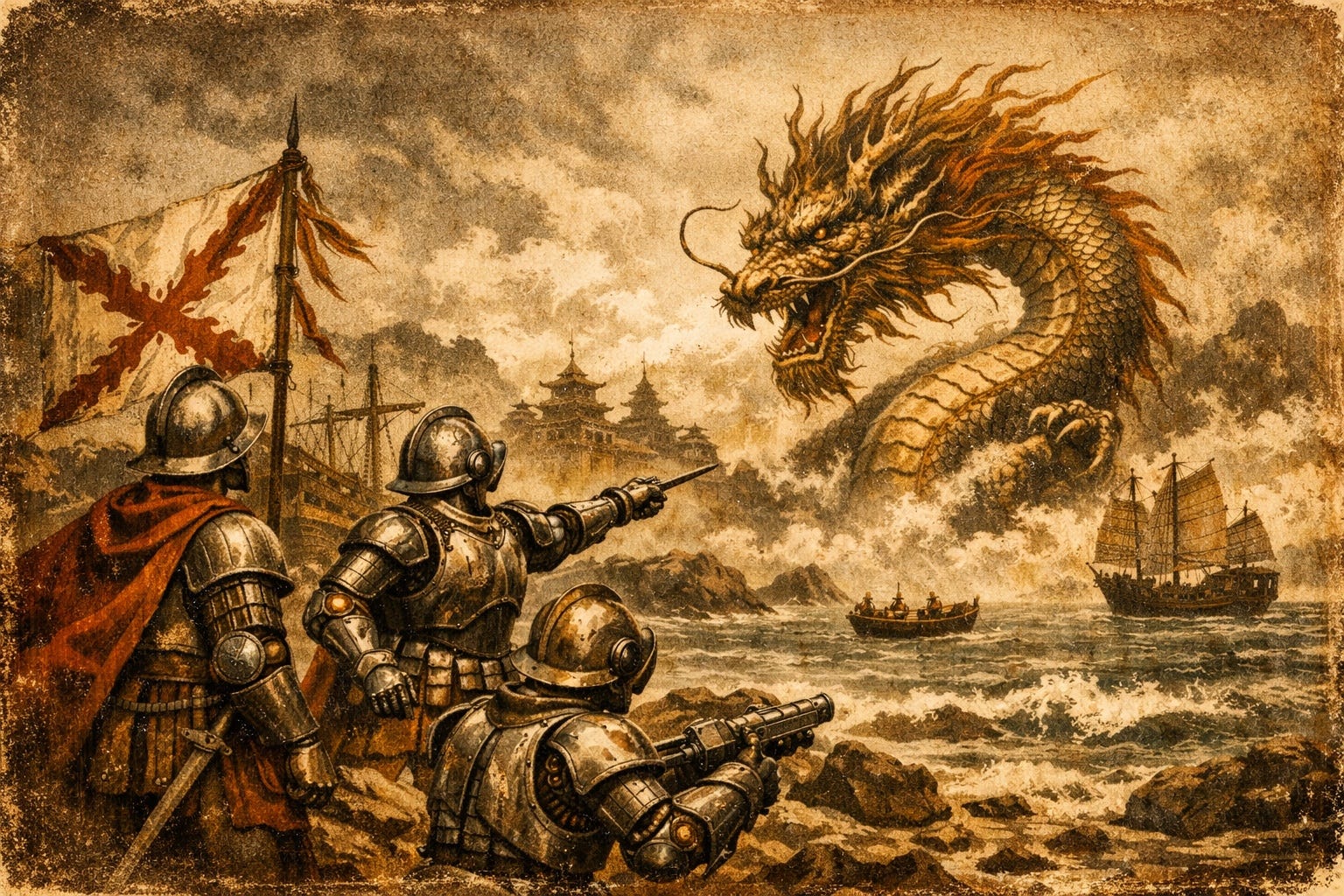
The great Spanish philosopher George Santayana once wrote in his 1905 work The Life of Reason: “Those who cannot remember the past are condemned to repeat it” Scrutinizing his wisdom, one may observe that beneath his words lies a beautiful paradox in the intricate dance between knowledge and inevitability. Indeed, his words fracture into three different dimensions, and the paradox manifests itself differently each time. In the inaugural dimension, emerges the predictive paradox, the most straightforward logical snare. Should history indeed unfold in a predictable cycle, and we acquire the ‘historical literacy’ to discern this pattern, we might, well at least in theory, possess the ability to intervene and alter the outcome. Funny thing is that, well, by altering the outcome, history ceases to repeat itself. Therefore we end up with;
If we know history, we change it (it doesn’t repeat)
If history repeats, it means we didn’t know it (or, sadly(?) couldn’t stopped it!)
Within the domain of following dimension, the enigmatic Hegelian Irony makes its appearance; offering a more cynical take. Hegel once told “what experience and history teach is this: the nations and governments have never learned anything from history” (At this point, I know you’re excited to be reached the realm of techno-politics but please, a little bit patience) The paradox lies in the notion that the sole lesson history imparts is our failure to learn from it. This engenders a cycle where repetition thrives on the inherently human inclination to think, “this time is different,” despite evidence to the contrary. In the ultimate dimension, Heraclitus’ Paradox unveils its splendor (commonly referred to as the same river problem, a concept you might recognize, right?).In the grand tapestry of existence, Heraclitus, the sage of Ephesus, proclaimed with profound insight, “No man ever steps in the same river twice, for it’s not the same river and he’s not the same man.” Thus, he captured the eternal dance of change and transformation, where the flow of time and the essence of being are in perpetual motion, weaving the fabric of life with threads of constant evolution. When one contemplates this in the context of history, the paradox emerges that true repetition is an impossibility. Even if a contemporary economic crisis mirrors one from 1929, the 2026 iteration unfolds within a world that bears the memory of 1929. Here, the existence of the memory changes the context of the event. Therefore, history can only “rhyme” (as Mark Twain allegedly put it), but it can never truly repeat itself.
The Predictive Paradox: The White House and the “New Great Divergence”
In the annals of history, the First Great Divergence of the 19th century marked a monumental epoch where Western nations surged ahead, their lands transformed by the relentless march of industrialization, while the East remained steadfast in its agrarian traditions. Yet, as the sands of time shift once more, the White House’s 2026 report heralds the dawn of a Second Great Divergence. In this new saga, the United States emerges as a titan, forging ahead with unparalleled “compute” investment, now commanding a formidable 25% of all U.S. investment. This audacious leap propels the U.S. beyond the horizons of Europe and China, setting the stage for a new era of technological supremacy and global dominance. In the grand saga of human progress, the United States stands as a titan, drawing upon the ancient wisdom of the first Industrial Revolution to forge a new era of innovation. Yet, in their quest for supremacy, they embark on a perilous journey through the uncharted waters of deregulation and dominance. As they strive to claim victory in this epic race, they risk birthing a world transformed beyond recognition; a world where the specter of AI labor propels GDP growth to dizzying heights of 40% or more. In this brave new world, the venerable lessons of history may crumble into dust, rendered obsolete by the very future they sought to create. The prophecy of leadership becomes a self-fulfilling prophecy, crafting a destiny that defies the very models of the past. They are subsidizing “compute” (the new coal) to ensure they stay on the right side of the gap. In its endeavor to avert decline by emulating past triumphs, the U.S. also is inadvertently ushering in a Technological Singularity, where the conventional paradigms of labor and value cease to apply. Should AI assume 90% of cognitive tasks, the historical insights concerning employment and taxation become obsolete. We are leveraging history to construct a future that will ultimately render the past unrecognizable.
The Hegelian Irony: Spain’s Quest Against “Techno-Oligarchs”
In the years 2025 and 2026, Spanish Prime Minister Pedro Sánchez and Foreign Minister José Manuel Albares have proclaimed a war on Big Tech, branding social media as a failed state. They have enacted legislation, such as the Law for Democratic Governance, to mitigate algorithmic manipulation and counteract the influence of the so-called techno oligarchs. Ironically, Sánchez even posted on the social media platform X (yes one belongs to the king, master, supreme ruler etc. of the techno oligarchs, Elon Musk himself!) “Let the techno oligarchs bark!” Here you go again, Hegelian Irony in action! Spain is engaged in a battle for “Humanism” against “The Law of the Jungle.” However, the techno oligarchs are employing the same historical tactics as the Gilded Age monopolists (please try to avoid thinking HBO series, just please). Spain’s struggle implies that while we are aware of the history of monopolies, we are “condemned” to repeat the same battle because human power structures have remained unchanged, only the tools (algorithms instead of railroads) have evolved. Spain is currently the “moral laboratory” of the West, and indeed shouting: ”We’ve seen this movie before!” In the grand saga of our digital age, the “Techno-Oligarchs” those mighty titans of AI and Social Media have ascended to a dominion surpassing the might of many small nations. Yet, amidst this towering power, Spain presents itself as a valiant knight, wielding the sword of justice to shatter the “Hegelian Loop.” With the might of the law, they seek to unveil the hidden workings of algorithms, striving to demonstrate that civilization possesses the wisdom to evolve, defying the grim lessons of history that whisper of our perpetual folly.
The “Same River” Problem: The Rise (and Pivot) of China - also there is this “Green” Thucydides Trap
In the annals of history, the emergence of a burgeoning power, such as China, inevitably leads to a confrontation with a declining force, like the United States. This phenomenon is known as the Thucydides Trap. However, China’s strategic vision for 2026 indicates an intention to “step into a different river.” China’s influence in this divergence exemplifies Heraclitus’s “Same River” paradox. While the United States emphasizes AI software, China has pivoted towards a Green Great Divergence, investing $250 billion in global green manufacturing, encompassing electric vehicles, batteries, and solar energy. In the grand tapestry of history, China’s rise unfolds as a saga unlike any before. The echoes of past empires clash with the present, as the Thucydides Trap looms, yet China charts its own course through the uncharted waters of a world woven with threads of interdependence and ecological fragility. Not content to mirror the legacy of Britain, China aspires to ascend as the Green Hegemon, a beacon of sustainability in a realm fraught with challenges. This is not a mere repetition of history; it is the tale of a unique voyager navigating a river more tumultuous than ever imagined. In lieu of vying for oil or traditional colonies(?), China has established itself as the so called Green Infrastructure Provider for the Global South. By asserting control over the supply chains essential for the energy transition, they seek to navigate the Great Divergence paradox by redefining “power” from military might to ecological indispensability.
Here Comes The Ultimate Paradox: The Speed of Memory
In the year 2026, the very essence of history feels askew, for our collective memory is now governed by the very AI we strive to comprehend. In the days of Santayana, “remembering the past” entailed the turning of pages in books. Yet now, “remembering the past” is an algorithm’s swift summary. Should this algorithm wield the power to filter our recollections, we find ourselves doubly condemned to relive the chapters of history that the “Techno-Oligarchs” have chosen for us. Indeed, “We are not repeating the past; we are being fed a curated version of it to ensure we don’t change the future.“
