

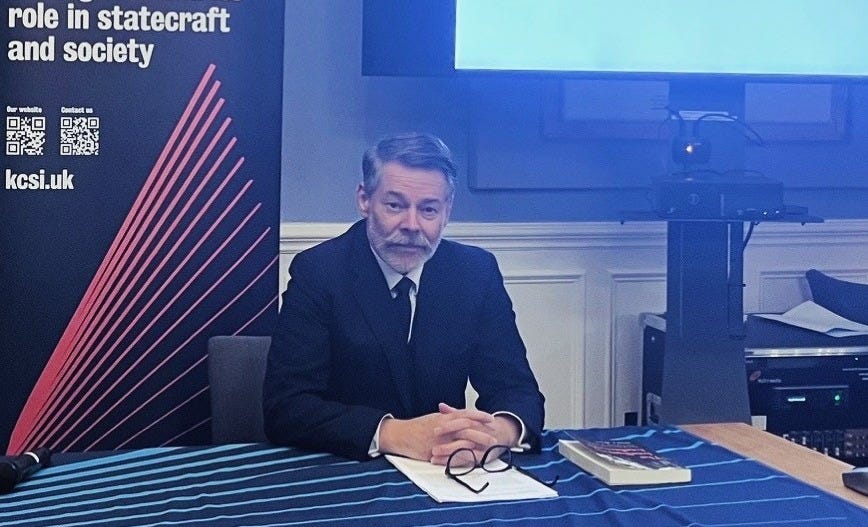
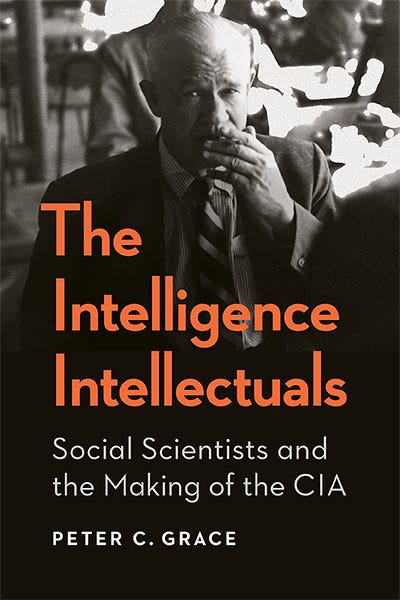
At TeknoPolitika.com, we are beginning a new series of conversations with leading scholars and thought leaders working at the intersection of technology, power, security, and intelligence studies. Our first guest is Dr. Peter C. Grace, a lecturer in politics and international relations at the University of Otago in New Zealand and Co-Director of the Otago National Security School. His latest book, The Intelligence Intellectuals: Social Scientists and the Making of the CIA, was published by Georgetown University Press in January 2026 as part of the Georgetown Studies in Intelligence History series. Drawing on newly declassified archival material and personal papers, the book examines how figures such as William Langer, Sherman Kent, and Max Millikan brought social-scientific methods into the CIA and helped reshape American intelligence analysis during the early Cold War.
Since its publication, Grace has discussed the book and its wider implications through seminars, public talks, and podcast appearances, and we are grateful to him for taking the time to answer our questions in such depth. From the CIA’s struggle for institutional legitimacy after 1947 to AI-era intelligence, from Sherman Kent’s “imponderables” to the prospect of a latter-day Oppenheimer, and from the rise of the “augmented analyst” to the changing relationship between universities, the state, and private technology companies, the conversation ranges widely. Particularly striking are Grace’s reflections on treating AI not simply as a technology but as an institution whose legitimacy still has to be earned, on the continuing importance of human judgment in intelligence analysis, and on the enduring value of those able to frame and reframe problems under conditions of profound uncertainty.
Alp Cenk Arslan, PhD. (ACA): The throughline I’m hoping to draw out is the parallel between the structural moment your book documents, a new international system after 1945 forcing a redefinition of what “intelligence” even means, and who gets to produce it, and the structural moment we’re arguably in now, where digitalization and AI are forcing the same question all over again.
Your book frames 1947-50 as a period where the CIA’s founding didn’t automatically confer legitimacy. It had to be built, through the four elements you describe via Zucker: a trained workforce, real expertise, a product competitors couldn’t offer, and demonstrated stakeholder demand. If you had to assess today’s AI-era intelligence and security institutions against that same four-part test, where do you think they currently stand, and where are they most exposed?
Dr. Peter C. Grace: Zucker’s model works for new institutions: the idea being that they are shaky at the very start and need to prove themselves. In the case of the CIA, the three “intelligence failures” of the Soviets getting the atom bomb early; China falling to the Communists; and the outbreak of the Korean War all undermined the Agency’s legitimacy as an intelligence provider, particularly one that provided estimative assessments. The central argument of The Intelligence Intellectuals is that the answer was to create an institution of civilian peacetime strategic intelligence, founded in social science disciplines. That meant creating civilian strategic analysts, with strategic analytical skills that differed from those in the military agencies, and which fulfilled an ongoing need of the national security decision makers. Zucker’s point is that without these four factors, the institution/organization will stumble or fail.
The question of whether AI-era institutions would stand up to the same model, and where they might be exposed, is a good one. We tend to think of AI as an unstoppable systemic force, not as a yet-to-be-tested but highly promising system of ideas, as social science was in the 1940s. And whether AI will provide a new institution that is similar to, or a development of, strategic intelligence as it was thought of in the 1950s is also an interesting question. By thinking of AI as an institution (rather than a technology), perhaps shaky in its early development, and not as a force that is sweeping the world without mercy, perhaps we can get a better idea of its strengths and weaknesses.
Zucker’s model also presumes the existence of a “workforce”. And our understanding of AI is that it replaces people and makes skills redundant. One of the other ideas explored in The Intelligence Intellectuals is the very intellectualization of CIA’s turnaround strategy. It wasn’t simply a matter of taking social science and applying it to the intelligence product. It was also about explaining to the decision-maker how it worked (justification for its conclusions), which is a problem we have right now with AI, where the workings are often obscured. Another factor that CIA’s analysts needed to consider was where social science ended, and the strategic intelligence discipline began. It was clear, for instance, that strategic intelligence sometimes required very urgent assessments where there was no time to collect the data and parse the evidence that social science requires to be effective. That often meant, rather than a well-tested conclusion coming from the scientific method, that a “guesstimate” was all that was available. Artificial intelligence promises lightning-fast calculations, but there may be some shortcoming where it doesn’t fit the requirements of strategic intelligence - one we are yet to discover. Going back to my previous point, we don’t know how AI might shape or change the very nature of strategic intelligence. We can also peel off strategic intelligence from the other kinds, tactical, for example, and from source types -like HUMINT and SIGINT- and consider whether it will be more effective in dealing with some intelligence products, and less in others. And for the foreseeable future, the problems that AI might encounter will be pondered by humans applying the technology to human problems.
Moreover, there was, as there is in any organization, a question of the allocation of resources - a management issue. While CIA’s early budget was big, and the workforce was growing fast in response to the need, the resources weren’t limitless, and very often there was a scarcity of good PhD-trained people, particularly in economic intelligence, where CIA could have very easily taken every economist coming out of the universities each year. In the case of AI, we have already seen that it is enormously energy-hungry, and we can see that there may be fantastic levels of investment needed for states who want to keep up.
Another thought experiment is if AI becomes a commodity where the adversary has matching AI power, as we saw in the nuclear weapons standoff. We may therefore see AI as a weapon that creates its own deterrence. We have thought of intelligence as a way of providing decision advantage, but it is possible that with AI the advantages will be shared equally (think of Gerschenkron’s argument that late adopters of technology benefit from the investments of early pioneers.)
Legitimacy, then, may become - at least in the early stages of AI implementation - something that is earned by human problem-solving: in the areas of intelligence verification, resource allocation, and discovering advantage. Failures of AI to deliver, or compromises that we realize we have to live with (as happened with social science) could lead us to use it less, or differently than what is currently anticipated.
ACA: The “intel intellectual,” as you define it, was a very specific historical figure. Langer, Kent, Millikan, seconded from Harvard, Yale, or MIT into the machinery of the state at a moment when the state urgently needed what only they could supply. Who is the structural equivalent of that figure today (not by name but as a persona), and are they coming from the same kind of institutions or from somewhere else entirely?
Dr. Peter C. Grace: One of the things I liked to imagine when writing the book was what it would be like to be placed in the same situation: where your social science skills were expected to predict the breakout of World War III, or to answer the almost impossible question of what Stalin or Mao was thinking. I imagine myself being shown to an office in the CIA building, and told to get on with it. We know that Sherman Kent experienced imposter syndrome in November of 1950. And I think I would have felt the same way.
The key to their success was not only the application of social science methods. It was the “bigger picture” thinking that they brought to CIA’s problems. For example, in trying to get a more accurate reading on the Soviet economy, Max Millikan created the Inventory of Ignorance, mapping not only what the CIA already knew, but where the gaps were in its knowledge. Another project which was mentioned in a 1952 “Intelligence Research Program” was a similar cataloging of all the possible research projects CIA might undertake to better understand the geopolitics of the time. They included a chronological history of the globe that could determine patterns and links; a list of “big” problems the world faced that could be broken down into smaller, more workable ones; sets of hypotheses about these problems; as well as case studies that might illuminate them. In other words, the thinking that was being done was managerial: it was about determining how to create a knowledge production line, one with inputs and outputs and, like any factory process, one that most efficiently produced profitable results.
It was also, in a more academic sense, one that was epistemological: a way of dealing with uncertainty. Uncertainty can reduce as more information is gathered and assessed. And therefore the anxiety that goes with it can lessen too. But, in true Socratic fashion, it also increases corresponding to what you know. You learn that you need to learn more. The AI-era institution is likely to follow the same paths, and both uncertainty and anxiety require a special type of person to manage them. Sherman Kent’s way of dealing with both was to be honest and admit mistakes frequently. He made it easy for others to follow him, because he created a culture within the CIA that was open about failings. (That’s not to say the culture was always present.)
Adrian Wolfberg has considered this in his new book Who Leads When AI Thinks? (Springer, 2026). He imagines the process of managing AI as being like a dance, where there is an interplay between AI knowledge and human judgment. Wolfberg says that humans still need to employ critical thinking (to challenge assumptions, test the logic, and check for bias) and creative thinking (to open up new ways of solving the problem, connect the dots in an original way, etc) when managing AI outputs.
It is no great revelation that organizations need creative thinkers as well as process-oriented and detail-focused ones. One of the probable benefits of doing a PhD is learning how to manage uncertainty and anxiety well. Whether PhD-trained people learn to be honest about their failings in a way that is collaborative is debatable.
A lesson from The Intelligence Intellectuals is that organizational leadership is just as important as innovation: the ability to force through change when there is resistance is as valuable as the insight needed to recognize what matters. The AI era institution/organization will require “benevolent dictators” like General Walter Bedell Smith and William Langer, as much as it will require creative thinkers like Sherman Kent and Max Millikan.
ACA: One of the more striking arcs in the book is the Princeton Consultants, set up as an external check on the Office of National Estimates, but over time the relationship inverted, and, as you put it, “the pupils became the teachers.” We’re watching something that at least rhymes with this right now, with frontier AI labs absorbing academic talent and increasingly outrunning the very institutions meant to oversee them. Does that historical arc offer any real lessons for how we should think about independent oversight of AI today, or is the analogy too neat?
Dr. Peter C. Grace: Firstly, the story of the Princeton Consultants is one of inbuilt redundancy in organizational change. I don’t think it was deliberately inbuilt, but it was logical that without the day-to-day exposure to problem-solving, and access to often rapidly changing classified information and even new methodologies, the Consultants would simply not keep up. They were formed in order to provide an external sounding board to CIA’s internally created assessments, and in a sense another way of calculating conclusions - in their case they may have arrived at different assessments through experience or even gut instinct.
I think there is room for gut instinct and experience in the AI-era institution. Gut instinct may be another name for “I have seen this problem/solution somewhere before, but I can’t remember where”. In other words, it is a human failing that has a silver lining. AI is supposed to find those links to insightful information and make gut instinct redundant too. But I doubt that it will, because the link that a human finds to solve a problem is much more organic. We can see a pattern in a cloud formation that will prompt a eureka moment. A comment that is misheard and interpreted as being something quite unlike what the speaker intended may also spark a breakthrough. It doesn’t have to be a fact or a solution that we have half-forgotten and which the AI machine can remember instantly.
There is also room for inexperience in problem-solving. As I said at the beginning, one of the narratives about AI is that it is a systemic change that is sweeping the world without mercy. That may be a view that experienced people have, a fear of change, or a belief that it is something dangerous that fits with science-fiction movies they have seen. It may not be the view of the inexperienced person, who only sees opportunity.
Again, with AI, we are seeing that the knowledge that is being produced is now feeding on itself, and AI learning is becoming prioritized over the human learning that kick-started it. It is a possible echo chamber, which is in itself an analogy for experienced thinking (groupthink).
The Princeton Consultants became, over time, a similar echo chamber. Think about how, as a PhD candidate, your knowledge of your research field surpassed, over time, that of your supervisor’s. The value that your supervisor could add, as you progressed, was often to provide guardrails to stop you from veering off track, or to second-guess the examiner’s criticisms of your final thesis. And this is very valuable guidance when you might no longer be able to see the wood for the trees. But as an actual contributor to your research, the supervisor often becomes redundant and gives you instructions or pointers that are repetitive and show the shrinking of their ability to add insights to your field. And this is what happened with the Princeton Consultants. The briefers from the CIA spent more time teaching them than coming back with new ways of looking at their assessments.
In the AI era institution, oversight may come from those who are not happy with the information that AI systems produce. And that disenchantment may not come from the people who built the machines. In the intelligence world, it may come from the policymaker who does not think the assessment fits with his agenda or worldview - for instance, the consumer who wants the intelligence “politicized” to pursue a direction they prefer. Having increased power, through AI, to speak truth to power does not necessarily mean the truth is acceptable. We worry that AI will replace our ability to think, but it may not replace the willfulness of those who don’t want to think. They may be the first to pull the plug on the machines.
Of course, we may see the opposite happen: where politicization becomes part of the algorithm, and we are already, to some extent, seeing that. But politicization does not usually lead to good outcomes; for example, the prosecution of pointless wars. You can have a backseat driver telling you the map you are looking at is wrong, and you should follow their directions to the destination you are aiming for. But it does not mean you will arrive at the destination, or that the backseat driver will be happy when you both realize you have traveled for several hours in the opposite direction. The political leader who tells AI to follow his agenda, and then realizes it is a bad one, may also pull the plug on the machines.
A third possibility is that the political leader relinquishes her decision-making function to the AI machine. It is possible better decisions might come from that. This could make the political leader redundant. However, given the likelihood that it will result in outcomes that are not desired, it is possible the political leader will find a new role, or an enhanced function, in providing oversight in the manner she was elected to - democratic oversight. One of the primary motivations for the intelligence intellectuals in working for the CIA in 1950 was their belief that the more you knew about the world, including about psychology, languages, culture, and societies, the more peaceful the world might eventuate. If, out of sheer fear they will be out of a job, the political leader thinks more about the effect decisions have on her constituents (national or global), then this might be a happy outcome.
ACA: Kent’s humility about “the imponderables”, his insistence that intelligence work meant living with irreducible uncertainty, reads almost as a virtue in your account. That’s a hard posture to square with how AI-driven prediction and assessment tools are marketed and used today, which tend to project confidence rather than humility. Is there a version of Kent’s epistemic caution that’s even possible in an algorithmic intelligence environment, or does the technology itself work against it?
Dr. Peter C. Grace: I think, following on from the last comments, we could consider the “augmented analyst”, which is a more optimistic reading of how the intelligence analyst’s role might be improved with AI while still keeping the human at the center of things; and different again from a role where the analyst is sidelined by AI or made redundant entirely. And depending on where he or she sits: as a co-driver with AI, or a passenger, or no longer a traveler, there will be a corresponding factor of empowerment and accountability. For those who have less, there will be less stress over uncertainty; for those who have more, my prediction is that the anxiety will not go away. You can rely on any kind of automated process, whether it is mechanical or informational, but if your neck is on the chopping block if it fails – and the stakes for national security are far higher than most processes – then you will always feel an effect of uncertainty.
George Kennan also talked about the imponderables, and he seemed to see the ability to work with uncertainty as a special gift: a willingness to think about the unknown, the unimaginable or unpredictable. Kennan had the top foreign policymaking job when he headed up the Policy Planning Staff in the State Department, and he relished the fact that his intellect was valued and recognized. When he left it, partly because he was burned out, he worried that his special gift might not be wanted back in Washington DC again. So, while Kent saw the imponderables as being something that might mean possible failure, Kennan saw them as an opportunity to succeed and stand out from the common man.
So we may see that opportunity increase in the new AI environment. The role of the augmented analyst will be to frame the intelligence problem and then, as the intelligence cycle expects, to review and reframe it as he or she engages with AI. That will require a much closer relationship with the policymaker, and more of a conversation about the scoping of the research that AI will then execute. So, and again I cite Adrian Wolfberg, there will be Albert Einstein’s view that he would spend 55 minutes defining and framing the problem and only 5 minutes coming up with a solution. This ability to work with the imponderables in framing and reframing may come to be seen – again – as a special human gift.
ACA: Your conclusion argues that intellectual and informational power became inseparable from US state power during this period. You couldn’t have one without the other. As that power increasingly sits with private technology companies rather than universities or government agencies, does the twentieth-century model of the “intel intellectual” moving between academia and the state still make sense as a framework, or has the relevant boundary shifted somewhere else entirely?
Dr. Peter C. Grace: We have seen marked changes in the U.S of private technology companies being co-opted (or more recently coerced) into contributing to Washington’s informational power, particularly in the decryption and AI domains. This is something we take for granted in authoritarian states, and it fuels a belief that informational power is becoming employed for more dystopian and less peaceful purposes.
On the other hand, we see a growing OSINT movement, of which Bellingcat is just one example, which has no allegiance except perhaps to the truth. And there is enough open source data out there still to show that informational power can stay democratic, although the capacity of AI in state hands may outstrip the capacity of non-state actors.
The social science departments in the universities are still debating the old basic versus applied research issue. There is a great history of this in Michael Desch’s book Cult of the Irrelevant (Princeton University Press, 2019). Desch does a very good job of showing the academics’ reluctance to get corralled into working for government. It goes back to Kennan’s belief that being able to work with imponderables was a special gift: academics prefer to break new ground rather than to focus necessarily on everyday government problems. As detailed in The Intelligence Intellectuals, it was partially the excitement of being able to apply the new social sciences to big societal problems, including national security, that drew academics to government work in the 1940s-50s. That, as well as being closer to the seat of power and being able to influence decisions from a better vantage point than the university.
A linked issue is the right to “speak truth to power”, which universities guard jealously, even at the expense of continued state funding. There’s no question that the intelligence intellectuals also valued their independence: some of the later people in this category, like Chalmers Johnson, were prepared to sever their relationship with the CIA to keep their integrity intact. So, the question is: how important is academic freedom to pursue pure research or take an objective position - neither of which might suit the state’s immediate agenda in contributing to informational power?
Finally, there is the question of whether the pursuit of peace is relevant to state power or not. Kent in particular was motivated by what he saw as the CIA’s ability to influence peaceful solutions by understanding the world better. It may seem an unlikely motivation in the Cold War, but we must remember that he had lived through the Second World War and believed that another one, this time with nuclear weapons, was an existential danger. Kent did not appear to want informational power simply for its own sake, or to expand US power over other states. And even if, as many would argue, US power did increase relatively, this was not the driver for Kent to work in government.
Neither was there a profit motive in working for government in the 1940s-50s. Most academics took a pay cut to do so. So there must have been an alternative measuring stick: one that was about service to a higher ideal. Whether you can still co-opt today’s intelligence intellectuals into the national security sector is somewhat conditional to the task and the motives of the state. The private technology companies seek profit and funding for more research, which is in turn a source of new profit. The academic will want reassurances that he or she isn’t some latter-day Oppenheimer.
There is still a need for those skilled at dealing with the imponderables, and the job of framing and reframing national security problems is, for the moment at least, in the hands of the human thinker. And there is still a suitable training ground for that thinker in the university, which is also still a fomenter of new ideas. One of the key ideas about presenting the history of the intelligence intellectuals was that they brought clarity to very fast-changing environments like the early Cold War, when people did not understand what was happening, nor what the implications would be. That is needed now, as much as it was needed then. There is plenty for the university to rise and respond to without worrying too much about private technology companies making it redundant.
ACA: Thank you very much, Dr. Grace, for taking the time to share such thoughtful and wide-ranging reflections with us. It has been a real pleasure to discuss The Intelligence Intellectuals and to explore what its history can still teach about intelligence, AI, human judgment, and the enduring challenge of the “imponderables.”