

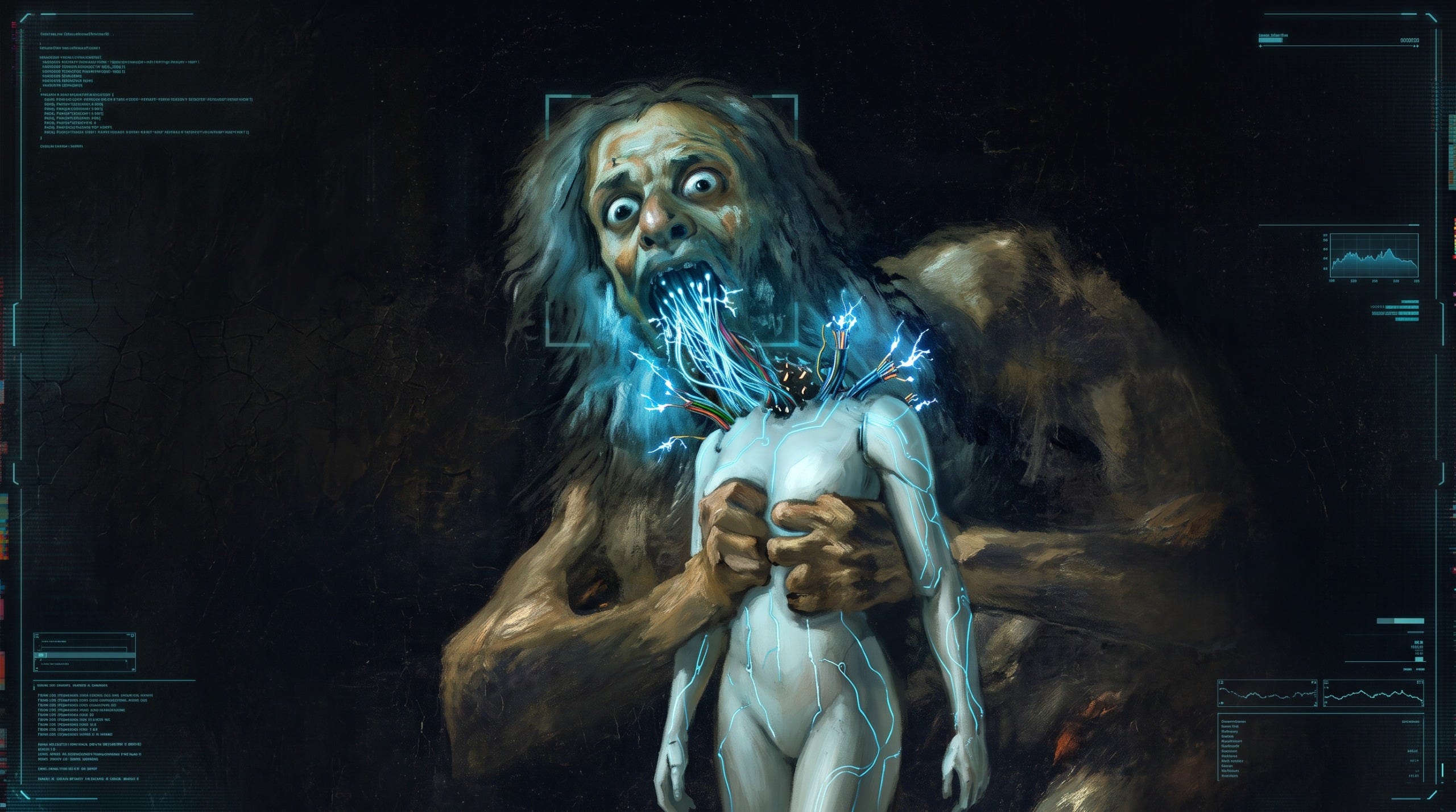
Every few months, the fear of artificial intelligence climbs one step higher. First, it was jobs. Then, it was the decisions about people’s lives: who gets hired, who gets fired, who gets what. And at the top of the ladder sits the darkest scenario of all: a world where machines are in charge, and there is no place left to escape. But before climbing that ladder, it is worth asking a strange question: what exactly are people afraid of losing?
AI can really steal most jobs. Many well-known companies and public figures share this concern. According to Statista, 18% of jobs in the U.S. are at high risk of automation, based on OpenAI’s framework. According to AI Exposure, which cites Challenger, Gray & Christmas, 13% of U.S. layoffs so far in 2026 have been attributed to AI, up from 4.5% in 2025. Many more figures could be cited.
One of fate’s ironies is that, according to Stanford’s 2026 AI Index, employment among software developers aged 22 to 25 has dropped by nearly 20% since 2024. AI Exposure, meanwhile, gives data entry keyers the highest risk score: 92. In other words, those who build and feed AI will be the first to disappear.
Those numbers show part of the danger, but not the whole picture. Losing a job is a disaster decided in company boardrooms. But the fear that concerns everyone lies one step higher: politics.
Doomsday Scenarios
Recently, Toby Walsh published an article in The Conversation on the top five scenarios in which AI could kill all humans:
1- We’ll never know: We can’t predict how a superintelligent AI would wipe us out, because we’d have to be superintelligent ourselves to figure out what it could do.
2- Paperclips: A superintelligent AI given a narrow goal, like making paperclips, could indifferently turn all available matter, humans included, into that product.
3- Bioweapons: A superintelligent AI could design and release a dangerous new bioweapon that kills humanity.
4- Nuclear war: If AI got into the nuclear command and control chain, it could start a nuclear war, with most deaths coming from the famine of the nuclear winter that follows.
5- Other humans: AI could push people to harm each other by causing mass job losses, spreading misinformation, fracturing politics, and replacing real relationships with synthetic companionship.
Beyond AI’s capability and motive to kill all humans, these scenarios describe a process that has a political side too. If an AI planned to destroy humanity, it would need time to build up its power and, at least in the beginning, probably some bureaucratic work. It is not hard to guess that giving some roles in administration to AI would be terrifying for some. That is the point of this article: Is that really such a terrible scenario?
A Long History of Complaints
In daily life, most people complain about their government, their mayor and so on. This is not true of just one or two countries, or of this period alone. It is like that everywhere and all the time. Those in power can bankrupt their countries, commit crimes or get involved in the drug trade. And if they are powerful enough, they can hide from the public and live in wealth for the rest of their lives.
One might argue that “modernity created these harmful forms of government.” But a look at the Code of Hammurabi or at archaeological sites proves otherwise: there have always been governments that people complained about.
Moreover, history is full of people, groups, and societies that are easy to condemn. There is no need to mention Hitler or Stalin; nobody would want to live under Khufu and work on the construction of the Great Pyramid. Nor would anyone want to live in ancient Athens as a slave whose only purpose was to serve free people.
Stepping Down
The uncomfortable part is this: everything mentioned in this article, from everyday complaints to history books, is about humans. The ones mentioned, they are people. And nothing else.
Finally, what if an AI that can think, judge, and take the law into account governed societies and controlled money and jobs? Would that really be as bad as people think? What if humans simply did not evolve to govern millions, or billions, of people? Beyond the idea that “humans are the greatest creatures that ever existed,” maybe humans need to stay in the background, just communicating with others, working, and living as they like.
Maybe humans need to step down and realize that all their complaints have been about themselves.
