

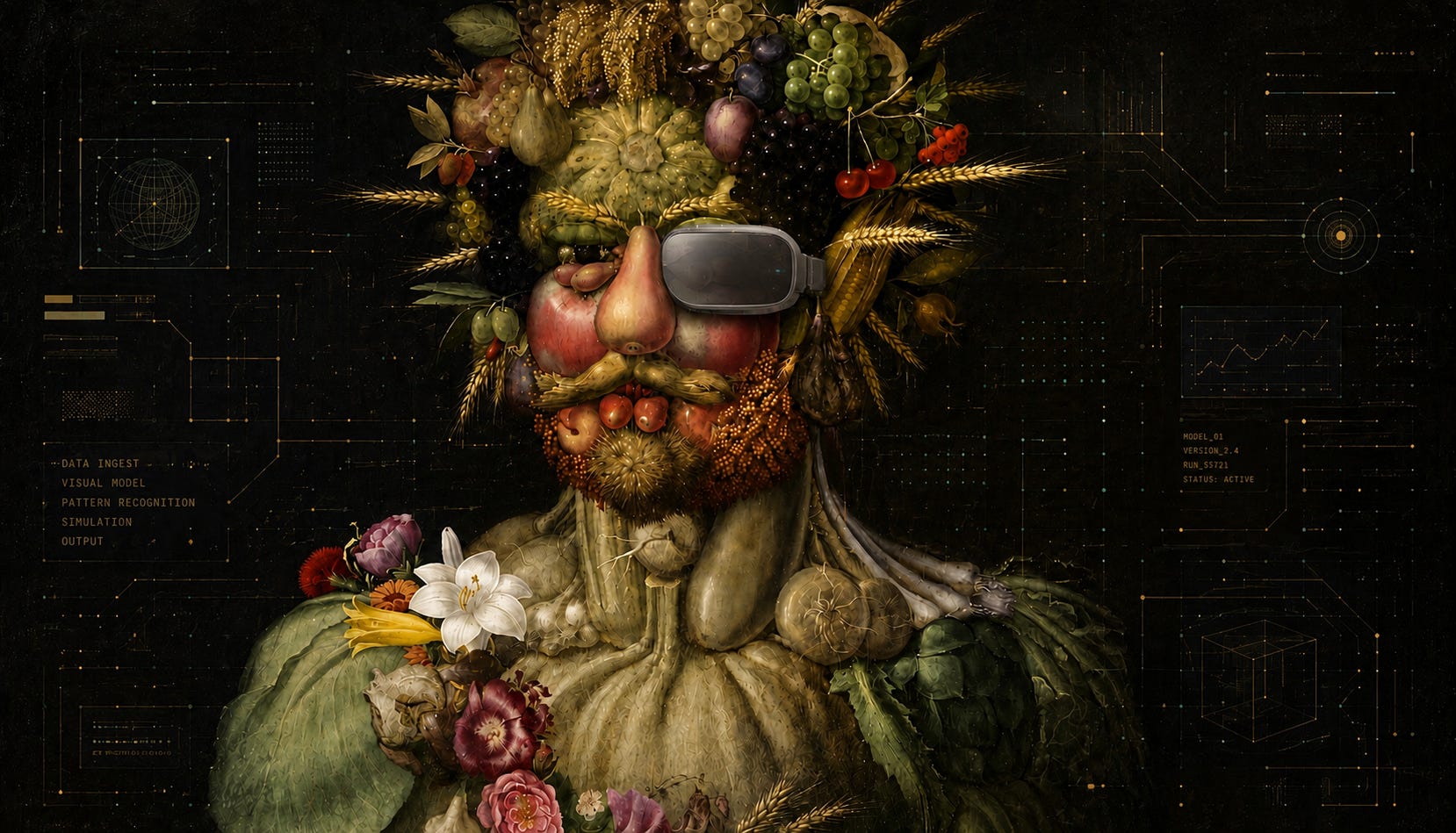
Long before Silicon Valley billionaires surrounded themselves with artificial intelligence researchers, futurists and engineers, an emperor in Prague was already experimenting with a strikingly similar political logic. It was the concentration of technical knowledge around sovereign power. Under Rudolf II, Holy Roman Emperor from 1576 to 1612, Prague became a magnet for astronomers, mathematicians, clockmakers, instrument builders, metallurgists, alchemists, astrologers and artists. This article seeks a discussion on the traceability of techno-politics more than an historiographical attempt.
His environment was not simply a state of intellectual diversity, but the way it was organized around imperial authority. Holy Roman Emperor Rudolf’s court can be read as an early form of techno-politics. It was a system in which knowledge, instruments, measurement and spectacle are not separate from power, but actively constitute it. From a modern perspective, Rudolf’s intellectual world appears internally contradictory. Astronomy coexisted with astrology, metallurgy with alchemy, mathematical precision with esoteric speculation, in stark contrast to George Bush being surrounded by such people, though. Yet this contradiction is less important than it first seems. In the late sixteenth and early seventeenth centuries, the boundary between “scientific” and “non-scientific or pseudo-scientific” knowledge was still fluid. What unified these practices was not their epistemic validity in a modern sense, but their shared promise. It was to make aspects of the world knowable, measurable, predictable or transformable. Rudolf’s court was therefore structured around four political verbs that remain recognizably modern. To know, to measure, to transform and to display…
Knowledge as Imperial Infrastructure
The most visible expression of this logic was the imperial knowledge network Rudolf assembled in Prague. Famous figures such as Tycho Brahe and Johannes Kepler are often treated as milestones in the history of astronomy, but their presence at court also reflects a political strategy. Brahe’s extraordinarily precise observations, later used by Kepler to formulate the laws of planetary motion, were not simply the product of individual genius operating in isolation. They were enabled by institutional patronage. In this sense, the emperor’s role resembles that of a modern platform owner more than that of a traditional scholar. He controlled the environment in which expertise could accumulate.
A similar pattern appears in the work of Jost Bürgi, the Swiss clockmaker and mathematician, and Erasmus Habermel, the imperial instrument maker. Their devices, precision clocks, astrolabes, quadrants, surveying tools and astronomical instruments, were beyond technical curiosities. The mechanical celestial globes produced in Rudolf’s orbit reconstructed them as objects that could be owned, displayed and studied within the imperial space. Knowledge, in this context, becomes something materially embedded in instruments, and instruments become extensions of political authority. This transformation is particularly clear in the domain of measurement. Surveying instruments and gunnery-related devices allowed territory to be converted into calculable space. Land could be mapped, divided, taxed, and defended according to geometric principles. The political sequence is straightforward but profound. Territory becomes measurement, measurement becomes information, and information becomes administrative power. In parallel, advances in metallurgy and mining, exemplified by figures such as Lazarus Ercker, linked technical expertise directly to fiscal capacity. The ability to assay ore, refine metals, and regulate coinage meant that knowledge of material processes could be translated into sovereign resources. At this point, techno-politics is no longer metaphorical, and it becomes a direct mechanism of state power.
Alchemy, Astrology and the Politics of Transformation
Yet Rudolf’s court cannot be reduced to a proto-scientific administration of measurement and control. It also included practices that modern categories would label as alchemy, astrology or esotericism. Scholars from all over Europe such as Edward Kelley, Michael Sendivogius, Michael Maier and Oswald Croll operated in intellectual spaces where laboratory experimentation, metallurgy, medicine and symbolic speculation overlapped. From a contemporary standpoint, alchemy is often dismissed as failed science. Politically, however, its appeal is easier to understand. It promised something far more radical than improved knowledge of existing resources. It was the possibility of transforming the material conditions of scarcity itself. The dream of transmuting base metals into gold can be read less as a literal scientific hypothesis and more as an early modern form of technological solutionism, the belief that technical knowledge might dissolve structural economic constraints.
Astrology functioned in a related but distinct way. Johannes Kepler, despite his foundational role in modern astronomy, also produced astrological interpretations for political patrons, including Rudolf himself. While astrology does not offer reliable predictive power in a modern scientific sense, its political function lies elsewhere. It provides a framework for organising uncertainty. For a ruler confronted with war, dynastic instability, economic fluctuation and environmental unpredictability, any system that claims to translate contingency into structured knowledge becomes politically valuable. Astrology, in this sense, operates as a technology of anticipation. Its modern equivalents are not mystical systems but economic forecasting, risk modeling, intelligence analysis and algorithmic prediction. The epistemic foundations differ, but the political demand remains constant. It was to make the future legible to power.
From the Kunstkammer to the Platform Sovereign
Seen from this perspective, Rudolf’s court begins to resemble a broader structure in which knowledge production and political authority are tightly interwoven. The imperial Kunstkammer, or cabinet of curiosities, is a key expression of this logic. It assembled scientific instruments, artworks, minerals, natural specimens and exotic objects into a single curated space. This was beyond a display of wealth. It was an attempt to symbolically contain the diversity of the world within the sovereign’s domain. Possession of rare, distant, or technically sophisticated objects implied a form of epistemic and political reach that extended beyond territorial boundaries. The Kunstkammer thus functioned as a technology of representation. It staged the ruler as the center of a world rendered knowable and collectible.
This is where the comparison with contemporary debates about “techno-feudalism” becomes analytically useful, even if it should not be taken literally. Modern theorists such as Yanis Varoufakis and Cédric Durand argue that digital platforms and cloud infrastructures concentrate power in ways that resemble feudal dependency structures, while critics warn that such analogies risk obscuring the specific dynamics of contemporary capitalism. Rudolf’s Prague is obviously not a precursor to Silicon Valley, but it does illuminate a recurring political pattern. Technological power is rarely located in individual inventions alone. It emerges from control over infrastructures, resources and networks of expertise.
Dependency, Spectacle and the Limits of Power
Rudolf’s authority did not depend on his personal mastery of astronomy, metallurgy or instrument design. It depended on his ability to assemble and sustain the ecosystem in which these practices could flourish. In contemporary terms, this resembles control over technological bottlenecks such as data centers, computational infrastructure, energy supply, specialized labor and capital investment. The ruler of an early modern court and the owner of a digital platform operate in radically different economic systems, yet both derive power from their position within systems of dependency and access. This logic also extends to spectacle. Rudolf’s court displayed mechanical marvels, astronomical instruments and rare artefacts not only for aesthetic appreciation but as demonstrations of capacity. Modern technological elites similarly stage public demonstrations of artificial intelligence systems, robotics and space technologies. These performances are not neutral exhibitions. They communicate authority. They signal that certain actors possess privileged access to the future, or at least to its technical preconditions.
Even the mythology surrounding Rudolf’s Prague reinforces this structure. The legend of the Golem, associated with Rabbi Judah Loew ben Bezalel, who lived during Rudolf’s reign, is a later cultural construction rather than a historical account. Yet its persistence is revealing. A city remembered for alchemy, mechanical devices, and esoteric experimentation becomes the imagined site of artificial life created through human instruction. The Golem myth does not describe actual technology. It expresses a cultural intuition about delegated agency and constructed power. In that sense, it belongs conceptually to the same landscape as Rudolf’s techno-political court, even if it operates in the register of myth rather than practice.
Rudolf II ultimately lost significant political authority to his brother Matthias, a reminder that technological patronage does not guarantee political survival. Knowledge, instruments and spectacle can reinforce power, but they do not replace the underlying dynamics of governance, conflict and legitimacy. Still, Rudolf’s court offers a durable analytical insight. Technological power accumulates not only through invention, but through the capacity to gather expertise, finance experimentation, control infrastructures, define standards of measurement and convert technical achievement into political legitimacy.
From this perspective, the most relevant questions for understanding both early modern and contemporary techno-politics are not limited to who invents the most advanced systems. They also include who attracts and organises expertise, who controls access to infrastructure, who defines what counts as valid measurement, who claims authority over prediction, and who transforms technological capability into political order. Rudolf II’s Prague demonstrates, in an early modern form, that power is not only exercised through coercion or law, but also through the organization of knowledge itself.
Editor’s Note: This article is the second installment in Ege Barış Kanık’s Techno-Political Reflections series. A comparative and interdisciplinary researcher specializing in Ancient Greek and Russian history and historical geography, Kanık explores how technology, knowledge, and political power have interacted across different historical periods and civilizations.
