

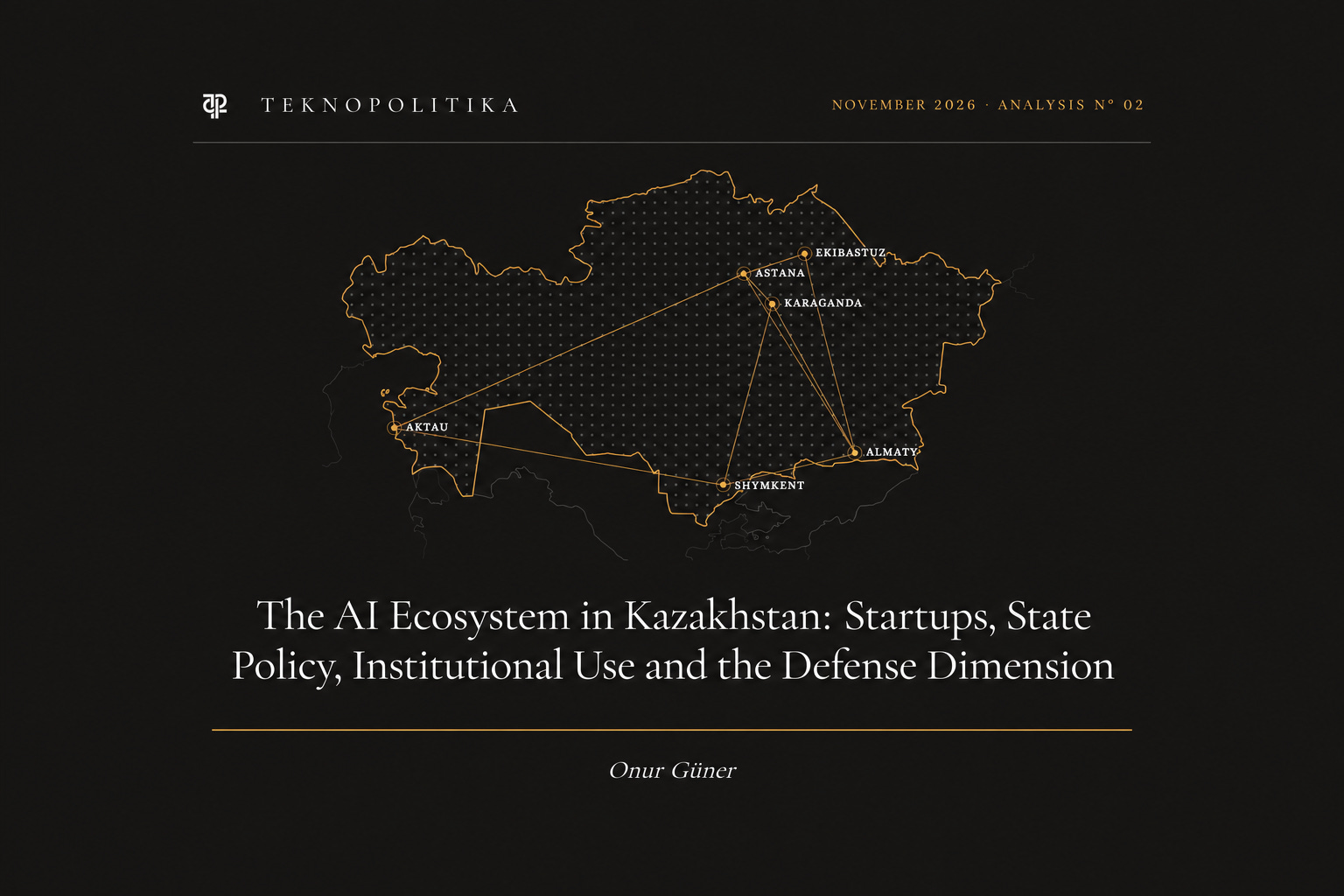
This report examines how Kazakhstan positions artificial intelligence (AI) as a national development project to diversify its raw-material-export-based economy, across four dimensions: the startup ecosystem, state policy and institutional framework, public and corporate use, and the defense domain. An open-source analysis based on official statements, RISE Research reports, and regional press shows that complementary steps have been taken since late 2025: a dedicated ministry, Central Asia’s first comprehensive AI law (No. 230- VIII), national supercomputers, and a potential data center package of up to $10 b illion. Venture capital directed at AI rose from roughly $14 million in 2023 to $73 million in 2025, and the country’s first unicorn, Higgsfield AI, reached a valuation of $5.4 b illion. However, a significant share of the indicators are targets or statements of intent; capital is concentrated in a single company, and both the implementation of the law and the military AI domain lack transparency.
Onur Güner is a defense industry professional and Master’s researcher in academic Intelligence Studies, working at the intersection of defense strategy, artificial intelligence, and international security. His research explores how emerging technologies are reshaping military power, intelligence, and strategic competition. Combining civilian-professional insight with academic inquiry, he focuses on the less visible forces shaping the future of security.
