


On July 24, twenty-five companies signed a letter to the Trump administration titled “Open Weights and American AI Leadership.” Nvidia, Microsoft, Meta, Dell, IBM, CrowdStrike, ServiceNow, Palantir. Andreessen Horowitz and Y Combinator on the capital side. Mozilla, Hugging Face, Mistral, the Linux Foundation.
Look at who is missing. OpenAI is not on that list. Anthropic is not on that list. Google is not on that list.
The three organizations that train the models everyone argues about were not parties to a coalition arguing about how models should be governed. They were the subject of it.
That is the thesis of this piece, and I want to be honest that it is a thesis rather than a proof. This is my read.
The question is not who builds. It is who decides.
We have spent three years asking the wrong question. Which model tops the benchmarks. Which lab has the better safety story. Whether Sam or Dario or Demis is the important one.
The question that determines outcomes is duller and harder to see: when a constraint gets imposed on the field, who imposed it, and could the target have refused?
Run that test on any recent fight and the hierarchy appears immediately. A model company can announce a position. It cannot make anyone comply. Nvidia can decide where its allocation goes and every lab reorganizes around that decision without being consulted. The Commerce Department can suspend access to a frontier model, and the company that built it complies within hours.
Same industry, same news cycle, completely different orders of power.
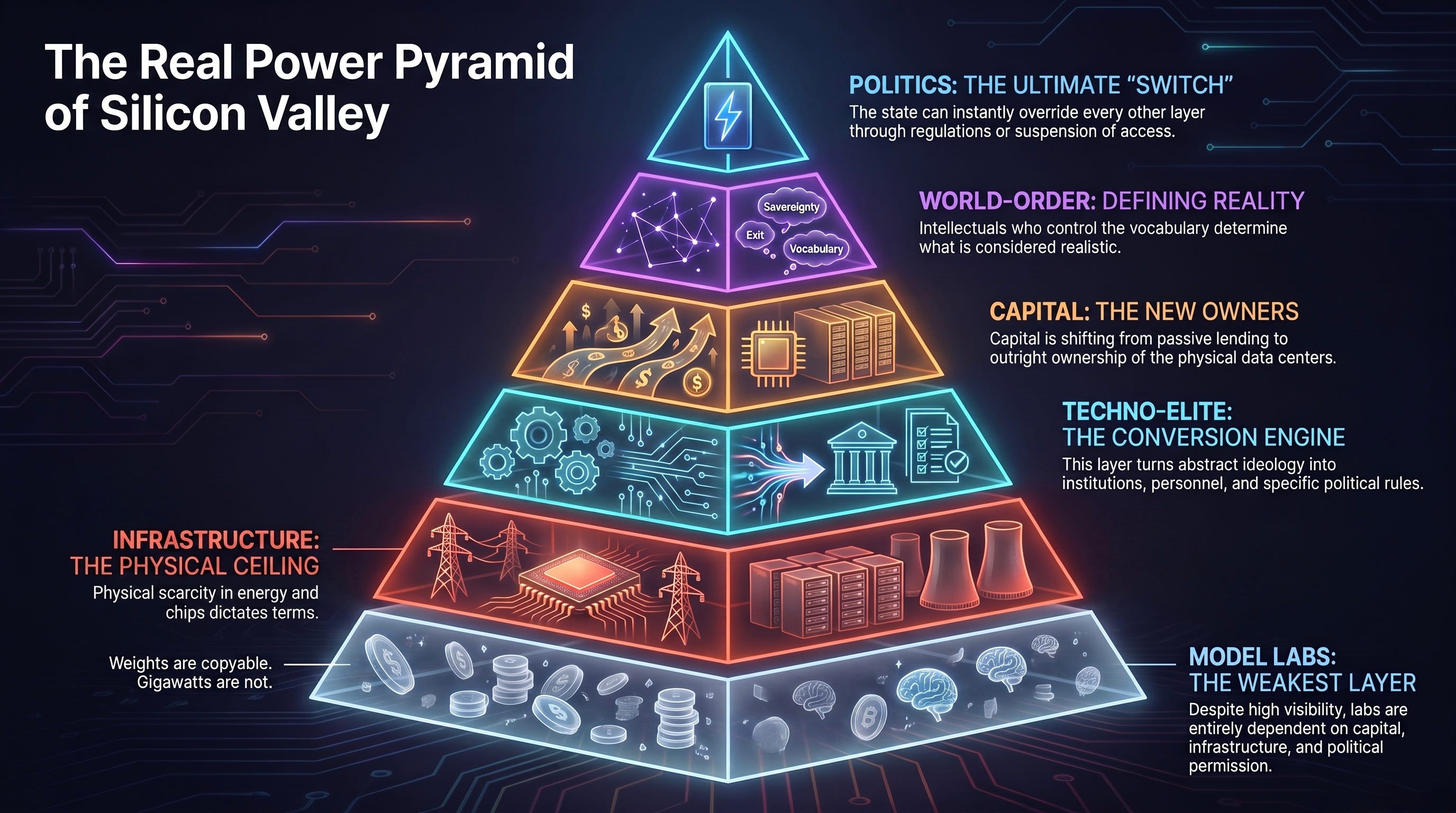
1. The world-order layer
This is where the ideology gets written, and for years we treated it as a curiosity rather than a power center.
The people here are not building companies. They are producing diagnoses of the present and designs for what replaces it. Curtis Yarvin, writing for a decade as Mencius Moldbug, argued that democratic government is a failed operating system and should be replaced by something closer to a corporation with a CEO. Nick Land took that material and gave it a name, the Dark Enlightenment, and fused it with his own accelerationism. Balaji Srinivasan turned the same instinct into a program with The Network State: if you cannot reform a country, start a new one, cloud first, land later. Exit over voice.
Peter Thiel sits across this layer and the ones below it, which is precisely what makes him the most interesting figure in the stack. In 2009 he wrote that he no longer considered freedom and democracy compatible. That sentence is now roughly the operating assumption of a whole donor class.
I want to be careful about what I am claiming. I am not saying these men run anything. Most of them have never managed a P&L or shipped a product. What they control is vocabulary, and vocabulary decides what is thinkable.
Watch the words move. Sovereignty. Exit. Parallel economy. Regime. Five years ago these were blog-post words. Now a chipmaker builds a product line around sovereign deployment, a defense software company publishes a manifesto about AI sovereignty, and a venture fund raises money to build a parallel economy of aligned businesses. Nobody on an earnings call invents that language independently. It arrives from somewhere.
Their time horizon is decades and their currency is the power to define what counts as realistic.
2. Capital
Capital sets the tempo, and this year it stopped being a passive allocator.
The clearest case closed five days ago. BlackRock’s Global Infrastructure Partners, Abu Dhabi’s MGX, and the Artificial Intelligence Infrastructure Partnership completed the purchase of 100 percent of Aligned Data Centers at an enterprise value near forty billion dollars, plus another five billion in growth capital committed at closing. Aligned runs 51 campuses and more than 6.4 gigawatts of operating and planned capacity. The consortium has signalled the vehicle can scale toward a hundred billion including debt.
Look at who is inside AIP: Microsoft, Nvidia, xAI, MGX, the Kuwait Investment Authority, Temasek. Larry Fink chairs it.
This is the single most important structural fact in the industry right now and it got almost no coverage compared to any given model release. An asset manager did not lend money to a data center company. It bought the data center company outright, alongside the chipmaker and the cloud provider that sell into it and a set of sovereign wealth funds that want a claim on the whole cycle.
Aligned no longer exists as an independent firm with its own strategy. It exists as an instrument. And a growing share of the physical substrate of AI is being reorganized on that model: not financed by capital, owned by it.
The consequence for the layer below is severe. Capital and infrastructure used to be two counterparties a lab could play against each other. They are merging into one counterparty that owns both the money and the concrete.
Capital does not need to understand mixture-of-experts routing. It needs to decide which trajectories get patient money and which get starved, and it now sits on both sides of that decision.
3. The techno-elite
If the first layer writes the ideology and the second holds the money, this layer is the mechanism that connects them. It is the visible face, and it is the part of the stack most people can name without understanding what it does.
These are actors who combine capital, ideology and political access. Their comparative advantage is conversion: taking an abstract diagnosis and turning it into an institution, a fund, a hire, a rule.
Rockbridge is the cleanest example of the conversion machinery. JD Vance and Chris Buskirk founded it in 2019, after Thiel introduced them, while Vance was working at Thiel’s Mithril Capital. It describes itself as something like a political venture capital firm, which is an unusually honest self-description. Reported membership runs between 150 and 200, dues between one hundred thousand and one million dollars, budget in the seventy to eighty million range as of 2024. Thiel, Rebekah Mercer, Blake Masters and Omeed Malik have been named among its backers; Andreessen and David Sacks are members. Buskirk’s argument, which he makes openly, is that every society has an elite and the only real question is whether it is extractive or productive. He wants to build the productive one.
Two things about Rockbridge matter for this essay. First, it produces institutions: 1789 Capital came out of a conversation at a 2022 Rockbridge summit about financing a parallel economy. Second, it produces personnel. A donor network that places people into an administration is not lobbying. Lobbying is arguing with the person in the chair. This is choosing who sits in it.
Palantir shows the same conversion running through a company rather than a donor list. On June 29 it announced an engine with Nvidia for running open Nemotron models in classified and air-gapped government environments, including letting agencies retrain the weights themselves. Two days later Karp went on television and said something had gone badly wrong with the way OpenAI and Anthropic price tokens, and pitched open weights as the escape route for executives who are tired of depending on the labs. Then Palantir signed the July 24 letter.
Read those three moves as one move. A company with no frontier lab of its own reframed the open weights debate around sovereignty and control, and pulled a chipmaker, several cloud vendors and the venture layer into alignment behind it. That is authorship of a debate, not participation in one.
Andreessen shows the third mode: setting the weather. When he attacks a lab, the attack becomes the frame the next month of commentary operates inside, whether or not it is correct. And on July 9 the new Fed chair named him co-lead of a task force on productivity and jobs, which means the most influential investor in the sector now has a channel into the institution that prices the money funding his portfolio.
Ideology, money, personnel, narrative. This layer moves all four, and it builds nothing.
4. Infrastructure
Chips, energy, land, cooling, interconnect, cloud primitives. I think this is the layer people underrate most consistently, so I want to be specific about why it wins.
Weights are copyable. Gigawatts are not. A model can be distilled, leaked, replicated, or made obsolete by a better one in six months. A substation cannot be copied. Neither can a fab, an advanced packaging line, or a signed twenty-year power offtake agreement. Scarcity that is physical stays scarce.
The clock speeds are mismatched, and slow beats fast. A frontier model is a six-to-twelve month cycle. A data center campus is three to five years. A new generation of fabs is closer to a decade. Whoever holds the long-duration asset dictates terms to whoever holds the short-duration one, because the short one has to come back and ask again next year.
Allocation is a private decision with no appeal. When a chipmaker decides which customers get capacity in which quarter, that is a sovereign act performed by a private company with no process, no hearing and no published criteria. It reshapes competitive position across the entire model layer, and the affected parties find out afterward. There is no other layer that can impose a cost that cleanly.
Energy is the actual ceiling, and it is where infrastructure fuses with politics. The binding constraints on AI buildout are now interconnection queues, transformer lead times, turbine availability and local permitting. Every one of those runs through a public authority. That is why infrastructure players have become political actors: not because they want to talk about AI policy, but because a siting decision in a county commission meeting can be worth more than a benchmark win.
Infrastructure is neutral across the model layer, which is why it can afford to be aggressive. It profits whichever lab wins. That structural safety is what lets a chip company publicly lobby for open weights, a position that reduces the pricing power of its own largest customers. You can only do that when you do not need any particular one of them to survive.
And now, after the AIP deal, this layer shares an owner with capital. The lab that wants compute is negotiating with an entity that holds the chips, the campuses, the electricity contracts and the balance sheet at once.
5. Politics
Here is where I changed my mind while writing this.
The comfortable story is that politics is downstream: private power gets built, and the state arrives afterward to bless it with export controls, procurement and regulatory cover. Politics as an interface that converts capability into permission.
June broke that story. Commerce restrictions took Fable 5 and Mythos 5 off the market on June 12. Anthropic suspended access to two frontier models it had shipped three days earlier and did not get them back until July 1.
That is not legitimation. The state did not ratify an arrangement that already existed. It reached into the frontier and throttled it, and the company that had spent years and billions building the thing had no move available except compliance.
So politics is not a layer in the way the others are. It is a switch. Most of the time it is off, and the stack behaves as though the state is a follower. When it flips, it overrides everything beneath it instantly, and the labs discover in real time that their sovereignty was always conditional. Three weeks of unavailability is not a regulatory inconvenience. It is a demonstration of who holds the final decision.
Which also explains why the layers above spend so much effort on personnel rather than persuasion. If the state can flip a switch that nothing else can override, the highest-value asset in the system is a relationship with whoever’s hand is on it.
6. The model layer
The most visible and the most overrated.
The labs produce the demos, the leaderboards, the safety reports and the existential rhetoric. They absorb nearly all of the public anxiety and nearly all of the public hope. Structurally they are the most dependent actors in the entire arrangement.
They depend on capital for runway. On infrastructure for compute and power, from an infrastructure layer that now shares owners with capital. On politics for the legal space to operate at all. And on the layer above them for the vocabulary in which their work gets judged. A lab that loses reliable access to frontier silicon or patient money does not stay a serious lab for long.
Which is why the July letter reads the way it does. Twenty-five signatories drawn from four layers of the stack, and the labs are not among them. When infrastructure, capital and the techno-elite argue with a model company, that is not a dispute between peers. It is a dependent layer being disciplined by the layers it depends on.
Where the friction goes next
None of this is stable and I would not bet on the current alignment lasting a year.
Infrastructure and capital agree right now because open weights commoditize the labs and push the value into silicon, deployment and distribution. That holds while the pie grows. When energy costs or capex cycles start to bite, capital will want returns that infrastructure would rather reinvest, and a consortium that owns both sides of that argument will find the argument happening inside itself.
The techno-elite and the political layer are the more interesting fracture. The people building channels into government are doing so on the assumption that the switch stays mostly off and mostly friendly. June showed the switch moves fast and for reasons that have nothing to do with anyone’s business model. Access is not control, and everyone acquiring access this year is going to learn that distinction the hard way.
And the labs will not accept the bottom position quietly. Their one genuine asset is that they define what capability means. If they cannot win on autonomy, they can try to become infrastructure themselves, which is the actual logic behind the inference buildouts and the long-term compute deals. Whether that works is the most interesting open question in the sector.
The point
We keep treating Silicon Valley as one organism and the model labs as its most powerful expression. Both assumptions are convenient and both are wrong.
It is a hierarchy of partially aligned and partially competing interests, and the companies training the largest models sit near the bottom of it. Impressive, fragile, extremely legible. That combination makes them perfect objects of public fascination and terrible proxies for where decisions get made.
The interesting story was never which model is winning. It is which layers are quietly writing the rules about what any model is permitted to become.