

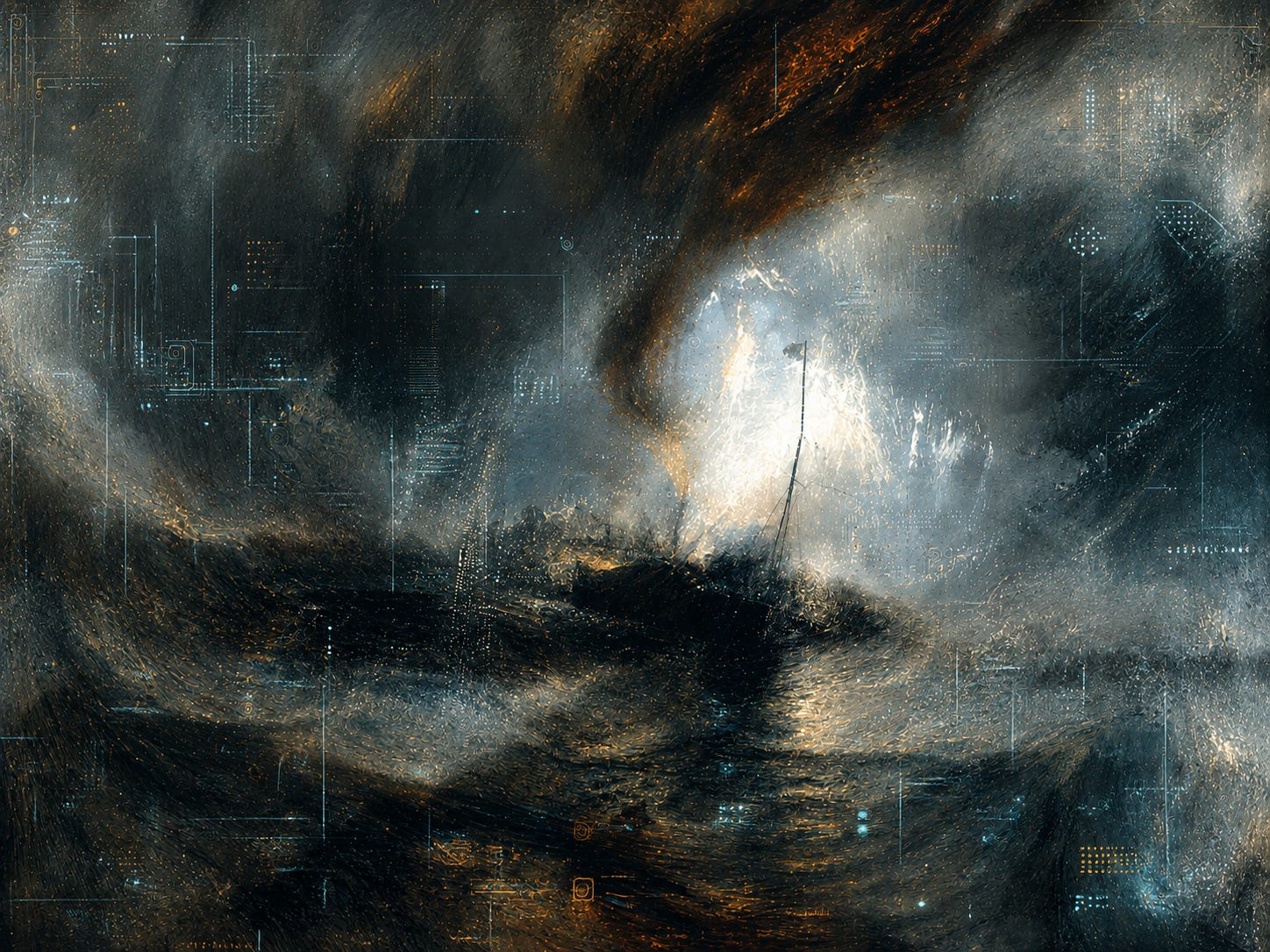
A vortex is indeed fascinating. It does three things at once. It draws loose matter toward a center. It reworks that matter according to its own rotational logic. Finally, it releases what remains back into the surrounding current. Matter is already changed by the end of the process. None of this is metaphor for its own sake. It is simply what a vortex does, mechanically, whether the matter pulled in is a leaf, a fishing net, or a shipping container. The vortex does not select for content. It only guarantees that whatever enters comes out differently than it went in.
This is a useful, and slightly uncomfortable, way to think about techno-politics as a field of analysis.
Consider what has happened to water management over the past several years. Irrigation scheduling, reservoir operation, and treatment-plant control were, for most of the twentieth century, engineering problems. Obviously governed by hydrology, agronomy, and municipal budgeting. They still are. But they are no longer only that. When programmable logic controllers at water utilities become targets of coordinated cyberattacks, or when agricultural AI systems start mediating irrigation decisions across entire regions, water stops being purely a resource-management question and becomes a question of critical-infrastructure exposure, foreign dependency, and strategic leverage. The underlying pipes and pumps have not changed. What changed is the logic through which they are now read.
The same absorption is visible everywhere one looks. Energy policy, once mostly a matter of grid engineering and market design, has been pulled into a vortex of supply-chain sovereignty and green-transition geopolitics. Agricultural policy has been pulled in through the AI systems now used for crop monitoring and yield optimization, turning food security into a question of who controls the models. Even historical and humanitarian subjects such as genocide accountability, disinformation governance, and the presence of extremist networks inside national militaries increasingly get folded into the same analytical field once they intersect with platforms, information infrastructure, or transnational coordination technology. None of these domains started as “techno-political.” Each was drawn in from elsewhere.
It is tempting to conclude that techno-politics is simply an expanding umbrella term, that “technology plus politics” is broad enough to eventually cover any subject, given enough time. But that conclusion misses what actually happens at the moment a domain enters the vortex. It is not merely relabeled. It is recoded. Three operations recur with striking consistency.
First, an object previously governed by technical or engineering criteria gets reframed as a strategic asset. Think about a water treatment plant. It stops being evaluated by throughput and starts being evaluated by attack surface.
Second, an actor previously understood as a sovereign, territorially bounded state gets reframed as one node among many. Who can deny that states are now competing with platform companies, infrastructure operators, and data-center consortia for effective control?
Third, a process previously judged by efficiency or output, by a simple industrial frame, gets reframed by its exposure to disruption. So, the question shifts from “how well does this work” to “who can make this stop working, and at what cost to whom.” Engineering logic gives way to security logic. Sovereignty logic gives way to network logic. Efficiency logic gives way to vulnerability logic. That triple substitution, not just the mere presence of a screen or an algorithm, is what actually defines the vortex’s center. When one thinks of Heidegger, it may be obvious, as it is, but living through it, experiencing it surely creates a distinct situation. It is obvious because “technology is a frame which affects how we understand nature and things” is an already accepted Heideggerian idea. Yet again, at first glance it is obvious that techno-politics is not offering a paradigm shift to be summed up as “once a water, now an energy source”. Techno-politics asks “who”, “whom,” and “why” questions. It perceives threats. It perceives opportunities. Rather than simple abstraction, it is a way of understanding and responding to life in its immediacy.
Maybe it is better if we retreat to our initial analogy. Arguing through connotations that are derived from analogies is unacceptable in a scholarly fashion. Yet it is undeniably effective. A vortex. Vortices are dynamic. They are turbulent, almost alive. Gestell, on the other hand, connotes stagnation. Yes, technology is still challenging nature and positions it as a resource to exploit. More precisely, it is a mode of revealing. It is mostly a fixed frame. Although there are objections, if something is only effective in revealing, it would never be effective on the essence, truly. By only revealing, it is not possible to talk about inevitable ontological consequences. Yet, the recoding function can still be observed in Heidegger’s work. Revealing something may be a certain way to shape one’s mind to understand that thing. Trying to imply something structurally ownerless is, on the other hand, to beat around the bush. In the end, gestell holds still for an unknown time while the vortex inside it never does.
Techno-politics and Heideggerian understanding of vortices and gestell drastically differ at this precise point. More accurately, at this point, techno-politics expands the Heideggerian approach. Techno-politics offers a dynamic understanding. It’s not a simple and unclaimed frame like Gestell is. It has a centre. It has a winner. It exists through obstacles, conflicts even. It does not simply reveal. It outright changes. Revealing an angle of something’s nature is indeed a way to shape perception, as we previously argued. Revealing in the Heideggerian sense isn’t an action performed on an already-there entity. It’s the event by which entities become able to show up as anything at all, even before the existence of any action, subject, or even objects. But changing is a whole different action. Changing presupposes a persisting thing that had property P, now has property P1, and something, mostly a subject, sometimes another object that causes confrontation, did that to it. There is a before and after, cause-and-effect mechanism. A subject acting on an object, whether directly or through another object.
One cannot imagine techno-politics as a vortex without the concepts of power and confrontation between powers. Gestell, on the other hand, is painted as a car with no one behind the wheel. Although it is argued that the car is being driven by an anonymous and historical being, an account that explains everything through epochal turns explains nothing in particular. While techno-politics doesn’t just reveal that there is a car and leave it there. It argues that if there is a car, there should be a driver. There should be a reason that we have this car, who produced the car, how the car works, and even car crashes and their consequences. Techno-politics delves into a much broader context and complex relations. How the essence is changing, who is changing it, and most importantly: why are they changing it? Techno-politics defies an inert understanding. It forces one to think about agents, thus becoming more critical and contextual. To sum it up, techno-politics is expanding Heideggerian understanding of technology and making it more applicable.
Let us return to the main argument. As we already said, techno-politics has a recoding function. The recoding operation has a name in critical theory: a domain is first stripped of the logic that used to organize it, then rewritten according to a different one, before being released back into circulation under its new terms. What makes techno-politics distinctive is not that this happens. Since all major analytical paradigms do some version of it, it wouldn’t have any distinction or importance whatsoever. Techno-politics’ distinctiveness is something different and may be even terrifying. It is how consistently the same recoding logic gets applied across radically unrelated domains: water, food, law, energy, society, sex, information, even memory and historical justice. The vortex is powerful precisely because its recoding template is portable.
That portability is also the concept’s central risk. A framework capable of absorbing anything is, by the same token, at risk of explaining nothing in particular. If every subject can be shown to have a techno-political dimension, the term risks collapsing into a synonym for “modern life,” losing the discriminating power that made it useful in the first place. Political science has a name for this failure mode: “conceptual stretching”. It is a risk worth taking seriously. The defense against it is not to police what may or may not enter the vortex. Almost anything eventually can and eventually will. The defense is to insist, case by case, on naming the specific recoding: which logic was displaced, and which logic replaced it. Rather than resting on the observation that technology and politics are, once again, somehow both present. Yet again, naming specific recoding mostly means pacification of human action. Thus, human existence itself. Still, naming has a metaphysical effect nonetheless. So hopefully, naming the events will ultimately lead to the will and capacity to act realistically. That is what techno-politics does.
There is one last thing worth saying about vortices, and it cuts against the intuition that they are simply engines of destruction. A stable whirlpool is not chaos. It is a structure that persists precisely because material keeps flowing through it. Physicists call this kind of self-sustaining pattern a dissipative structure. It does not exist despite the constant inflow of new matter. It exists because of it. Techno-politics behaves the same way. It is not a fixed body of subject matter that occasionally gets new additions. It is a standing operation, kept alive by the continuous arrival of domains willing to be pulled in and rewritten. Water, energy, food, information, memory, this and that … The list will keep growing, not as an accident of scope creep, but because that is what a vortex does. The task for anyone using the concept seriously is not to catalogue everything it might one day contain, but to keep specifying, precisely, what it does to each thing the moment that thing goes in and, by doing so, pointing out a realistic frame for what to do with it.
Cemil Caca Arslan holds a PhD in Public Law. His research focuses particularly on the fundamental implications of techno-politics and techno-feudalism for the state.
