

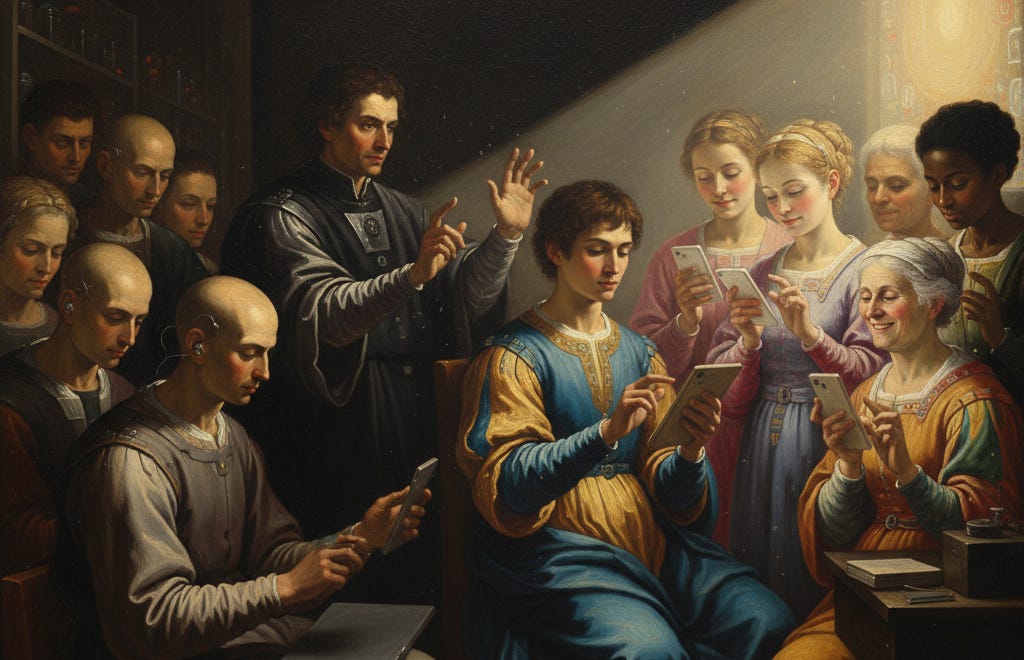
“The world order has died. Long live the new world order.”
This phrase, echoing across Munich, Davos, and Washington in the first weeks of 2026, is not hyperbole. German Chancellor Friedrich Merz stated it plainly at the Munich Security Conference: “The world order as it has stood for decades no longer exists.” Canadian Prime Minister Mark Carney called it a “rupture, not a transition.” The Trump administration’s latest National Security Strategy made it a doctrine: the American-dominated liberal order is over, not because America lacked power, but because it chose to stop sustaining it. The Munich Security Report 2026 is titled, without irony, Under Destruction.
We are not entering Orwell’s 1984. We are already living in Aldous Huxley’s Brave New World, and the scariest part is how comfortable it feels.
Orwell vs. Huxley: The Debate That Was Never Really a Debate
For decades, the literati have argued which dystopia would win. George Orwell feared control through fear, pain, and the deprivation of truth. Big Brother watches you. The boot stamps on the human face, forever. Information is rationed, history is rewritten, and rebellion is crushed with violence.
Huxley, writing Brave New World in 1932 and reflecting on it in Brave New World Revisited (1958), saw something more insidious. He feared control through pleasure, distraction, and engineered contentment.
“In the next generation or so,” he warned, “there may be a pharmacological method of making people love their servitude… producing a kind of painless concentration camp for entire societies, so that people will in fact have their liberties taken away from them, but will rather enjoy it, because they will be distracted from any desire to rebel by propaganda or brainwashing, or brainwashing enhanced by pharmacological methods.”
Huxley was right. We don’t need a thought monitor when the algorithm already knows what will keep us scrolling. We don’t need Room 101 when a dopamine hit from a perfectly tailored feed does the job better. As Neil Postman observed decades ago, Orwell feared those who would ban books; Huxley feared those who would give us so much that no one would want to read one.
In 2026, the evidence is overwhelming. We have Soma 2.0: infinite short-form video, personalized realities, and pharmaceutical-grade digital escapism. We have the feelies: immersive VR and AI companions that deliver pleasure without risk. We have the caste system updated for the algorithmic age: those with access to frontier models versus those fed only the sanitized, engagement-optimized slop.
The New Operating System: Techno-Political Soft Control
The old liberal order rested on institutions, norms, and American security guarantees. Its replacement is not a new set of rules written in Geneva or New York. It is an operating system, invisible, pervasive, and voluntary.
Power today belongs to whoever controls the pipes of attention, data, and narrative. In intelligence terms, this is the ultimate form of information warfare: not kinetic, not even cyber in the traditional sense, but cognitive and affective. States and corporations alike now compete in the attention economy, where the battlefield is your limbic system.
Look at the signs, analyzed through a proper intelligence lens.
Your reality is curated. One user sees climate optimism and consumption cues; another sees geopolitical threat assessments. Same platform, parallel universes. This is Brave New World’s Alpha-to-Epsilon hierarchy, achieved not by genetic engineering (yet) but by data and reinforcement learning.
Discussions of genetic editing for intelligence, longevity, and “optimization” are no longer fringe. Policy circles in 2026 openly debate germline editing frameworks. Huxley’s Bokanovsky Process and decanting rooms feel less like fiction every quarter.
The most chilling success metric? Users spend 4–7 hours daily on platforms that harvest their attention while making them feel empowered, connected, and entertained. We don’t resist the surveillance, we pay monthly subscriptions for better versions of it.
The next decade will not be decided by who has more missiles or chips. It will be decided by who masters the soft infrastructure of human desire. US-China tech competition is not about hardware; it is about whose models will shape global cognition. AI governance talks at the UN Global Dialogue and India’s AI Impact Summit this month are polite theater. The real game is already running in the background.
Only Viable Counter-Measure
In Huxley’s World State, the few who refuse soma, the Savages, the misfits, are exiled to reservations or eliminated. In our version, the cost of waking up is different: burnout, anxiety, or simply being algorithmically deprioritized.
This is precisely where personal alignment becomes your strategic edge.
Amid engineered distraction, ruthlessly auditing your alignment, matching what you love, what you excel at, what the world truly needs, and what sustains you financially, is no fluffy exercise. It functions like a rigorous intelligence assessment. Scanning for threats (misalignment, burnout) and opportunities (leverage, antifragility), so high-stakes professionals stop drifting in curated feeds and start shaping outcomes with clarity and purpose.
When your daily work sits in all four circles, you become antifragile to the new operating system. You stop sleepwalking through curated feeds. You start shaping the narrative instead of consuming it. You retain the capacity for deep, uncomfortable thinking, the kind that built the old order and will be required to navigate the new one.
I can attest: the Sunday dread disappears when alignment returns. Clarity becomes your ultimate competitive advantage in a world designed to erode it.
Rule of Three for Survivalists Today
Wake up to the operating system. Recognize that most “news,” “debate,” and “content” is Soma. Consume deliberately or not at all.
Build your personal alignment fortress. Audit the four circles ruthlessly. Double down on the overlap. This is your cognitive immune system.
Shape, don’t just survive. Use your expertise, whether in intelligence, policy, tech, or analysis, to influence the rules of the emerging order. The world still needs clear-eyed thinkers who refuse to love their servitude.
The old world order has died. Welcome to the Brave New World.
The question is whether you will remain happily medicated within it, or whether you will do the hard, rewarding work of staying awake.
The choice, for now, is still yours.
Do you envision a probable counter-narrative in which these same technologies and structural shifts enable greater human agency, pluralism, and institutional renewal rather than dystopian drift?