

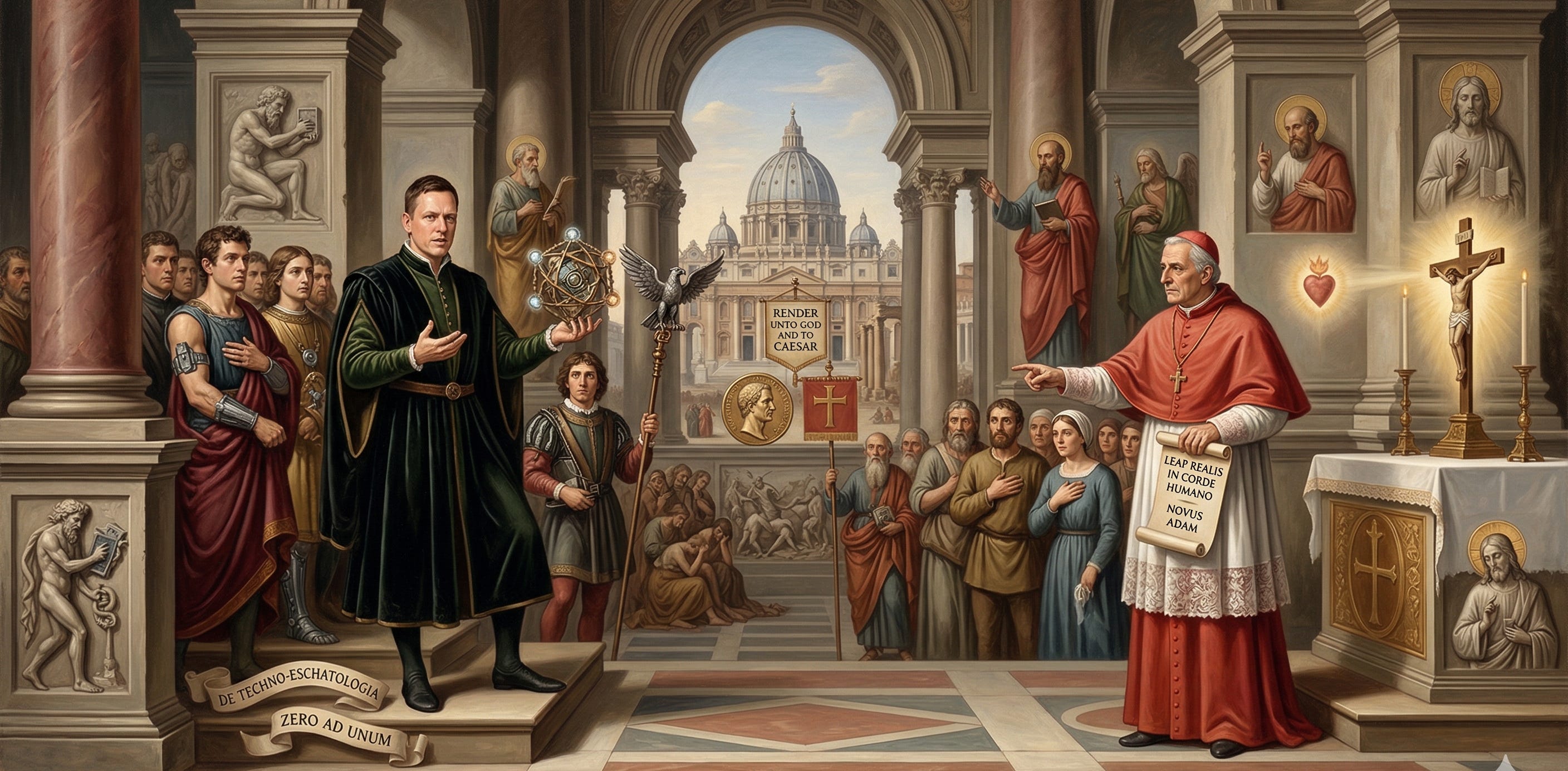
The Vatican’s newspaper, L’Osservatore Romano, has issued a clear message regarding Peter Thiel’s Rome seminar on the Antichrist and technology. In an article written by Eugenio Mazzarella, Thiel’s attribution of a “salvific” role to technology is sharply criticized. According to Mazzarella, the vision encapsulated in Thiel’s well-known book title Zero to One does not morally transform the human being; it merely places more powerful tools in the hands of the same old human. “The true leap must occur not in technology, but in the human heart.”
The following analysis proceeds through selected direct quotations from Mazzarella’s article. These quotations are included in relevant sections of the analysis to make visible the theological and conceptual backbone of the text. The final part of the analysis contains my own reflections.
The article by Eugenio Mazzarella interrogates, from a theological perspective, the narrative constructed by modern techno-elites around humanity, salvation, history, and power. At the center of the text lies a discussion of the nature of the role that Thiel attributes to technology. According to Mazzarella, Thiel’s “Zero to One” vision represents not a leap that morally transforms the human being, but rather an approach that expands existing human capacities. Within this framework, the article advances the argument that “the real leap must occur not in technology, but in the human heart,” and situates this transformation within Christian theology, where it is associated with Christ.
At this point, the text interprets transhumanist and AI-centered visions of salvation as a form of secular “soteriology.” This reading suggests that the boundaries between technology and soteriology (the doctrine of salvation) have become increasingly blurred.
“That Peter Thiel’s techno-theology has made its way to Rome is not surprising. A political theology inevitably entails a worldly apostolate, a search for adherents: followers, the awakened, the converted. The arrival in Rome was unavoidable. The issue, as always, is the ‘Constantinian’ resistance: to give to God what belongs to God and to Caesar what belongs to Caesar.”
Another point emphasized by Mazzarella concerns the structural significance of Thiel’s intellectual trajectory finding resonance in a symbolic center such as Rome. According to him, every political theology inevitably produces a worldly counterpart, with followers, spheres of influence, and claims of transformation. In this context, Thiel’s presence in Rome can be interpreted as part of a broader interaction between technology, belief, and power. The classical distinction invoked in the text – “render unto God what is God’s and unto Caesar what is Caesar’s” – points to the historical depth of this tension.
“Thiel’s arguments possess a certain appeal, especially for both old and new ‘temporalists’ of the Roman Catholic faith. There is no shortage of those who genuflect before his entrepreneurial genius and admire the ‘quantum leap’ promised by his technological preaching. For him, innovation is not about refining and maximizing profit from existing technologies, but about creating new ones – bringing into existence what does not yet exist, producing epigenetic leaps in technological evolution through start-ups.”
The article does not overlook why Thiel’s approach is attractive. For those who see technology as the engine of historical transformation, the idea of a “quantum leap” generates a powerful field of attraction. Thiel’s definition of innovation – not as incremental improvement but as the creation of the unprecedented – reflects a vision built on entrepreneurship, risk, and radical novelty.
“The problem is that this quantum leap, this claim to technological transcendence, rests – within Thiel’s techno-theology – on a fundamentally negative, even hopeless anthropology. There is no hope for the human being (as in Girard, read alongside Hobbes’s homo homini lupus). This perspective does not lead to a genuine transformation of the human. It merely results in the material caricatures of post-humanism – ‘enhanced’ or transhuman beings. By contrast, in religious anthropology, this quantum leap, according to Paul, means abandoning the ‘old man’ and creating the ‘new man’: leaving behind the man of the flesh (the man of Mammon), the old Adam, and moving toward the new Adam.”
Mazzarella argues that this vision is grounded in a particular conception of the human being. According to him, this approach understands transformation in terms of increased technical capacity, thereby sidelining moral and spiritual transformation. The text relates this position to more pessimistic readings of human nature found in Girard and Hobbes. Within this framework emerges a post-humanist horizon centered on “enhanced” or “augmented” humans.
In contrast, the article emphasizes that, in Christian anthropology, transformation has a fundamentally different meaning. In the Pauline perspective, the issue is the abandonment of the “old man” and the emergence of the “new man” – a transformation often described in the literature as ontological. According to Mazzarella, Thiel’s approach does not aim at such transformation, but rather at the expansion of existing human capacities.
“Thiel may be a technological genius, but he is not a religious one – at least not in the sense of the axial age, where Christ represents the culmination of a religious process that began in the Middle East and spread across the Mediterranean into Europe and the Western world. The transcendence promised by Silicon Valley’s technological ‘prophecy,’ Thiel’s ‘zero to one’ operation, merely equips the old human with new and immensely powerful tools. It keeps the human at ‘zero’ – the human of the flesh – and does not transform him into the new human of God’s spirit. His ‘technological miracles’ of value creation are but another version of the miracles of false prophets. They leave society as they found it – often in the slaughterhouse of universal history, where humanity’s worst traits persist unchanged. The techno-theological eschatology of Thiel and his circle, along post-humanist and transhumanist lines, ultimately serves the old human.”
For this reason, the article participates in a broader debate about the relationship between technological progress and human transformation. One of its central axes is the tension between the transformative power of technology and the possibility that the human being remains fundamentally unchanged. The expression “false prophecy” can be read as a conceptual warning against overburdening technology with excessive meaning.
“According to this security-driven logic, Thiel’s human remains the human of the ‘age of stone and sling,’ as in Quasimodo’s 1947 poem Uomo del mio tempo. This human is still an extension of the man of the flesh, kept in the cave and prevented from ascending to a more real, more illuminated world (Plato). Yet the human being should be oriented toward better potentials.”
One of Mazzarella’s striking references concerns the nature of modern humanity. Drawing on Salvatore Quasimodo’s poem, he suggests that despite technological progress, the human being may remain essentially unchanged. This interpretation points to a divergence between technological development and ethical-ontological development.
“No totalizing technical Prometheanism can achieve this. The belief that artificial intelligence can govern the entirety of the human being sees no hope in the human heart or in that which could transform it. In this view, the greatest danger of the human is freedom itself, because humanity has eaten from the tree of knowledge of good and evil. Yet there is no ‘reverse bite’ that can undo this act, no way to return the apple to its original state, no means of restoring human consciousness to darkness – or to a point where God would regret having granted it. Certainly not by entrusting humanity to corporate managers who see themselves as the administrators of such a reversal.”
In its final section, the article turns to artificial intelligence and claims of technological governance. The issue at stake is the limits of viewing the human being as a fully governable entity. The text argues that this approach treats human freedom as a problematic element, whereas freedom is in fact a constitutive dimension of human nature.
The metaphor of the “reverse bite” is particularly powerful. It underscores the irreversibility of the human condition and sets a boundary against technologically deterministic approaches.
📌 My Notes: The Political Theology Behind the Thielian Vision
In my view, the core issue is not that Thiel attributes excessive meaning to technology. The deeper problem is that technology in the modern world is increasingly positioned as a quasi-soteriological authority claiming to determine human destiny. For this reason, the discourse surrounding Thiel is less a narrative of innovation and more the language of a secularized eschatology. Technology becomes the threshold through which salvation, chosenness, and the production of a “new human” are imagined. Once technical reason forgets its own limits and begins to intervene in the ontological question of the human, it ceases to be merely a regime of production and becomes a regime of belief.
For this reason, I read the Thielian vision not only as transhumanist, but also as a post-political theology of power. Politics has long ceased to be a public arena for debating the common good. It has been replaced by the governing claims of technological elites who believe they possess privileged knowledge of history. Within such a framework, humanity is no longer conceived as a community of free citizens, but as a flawed species to be optimized. Governance shifts from persuasion to design, from representation to engineering; from political plurality to technical synchronization. It becomes one of the new forms of modern sovereignty – a technocratic messianism that subjects humanity to a transcendent plan without God.
At this point, it seems clear that the debate this issue has generated in Western public discourse cannot be reduced to a binary of Christianity versus anti-Christianity. At a broader level, what is at stake is the meaning of human transformation itself. Is human transformation a moral, existential, and political process? Or is it a technical upgrade defined by increased capacity, extended lifespan, cognitive acceleration, and algorithmic alignment? The Thielian trajectory leans toward the latter. This, however, does not elevate the human – it reduces it. The human being is a tragic entity, living within questions of meaning, limits, guilt, freedom, responsibility, and transcendence. Any technology that seeks to eliminate this tragedy ultimately flattens first metaphysics, and then the human itself.
What we are confronting, therefore, is the diagnosis of a new language of sovereignty. Certain figures in Silicon Valley are making normative claims about human nature, history, and order – and more importantly, legitimizing these claims through the discourse of technical efficiency. Any project that advances such sweeping claims about humanity’s future must first make its anthropology explicit. How does it understand the human being? Does it treat freedom as a possibility or as a risk? Does it regard imperfection as a bug to be eliminated, or as a constitutive feature of the human condition? Without addressing these questions, every promise about the future risks becoming a design for depoliticized domination.
In the final analysis, Mazzarella’s objection is one that deserves serious political consideration. At its core lies the insistence that humanity must not be surrendered to totalizing technical horizons that claim monopoly over the language of salvation. Technology undoubtedly expands human possibilities. But the question of what the human is, what it may become, and to what extent it should be transformed is far too important to be left solely to engineers, investors, or corporate influencers.