

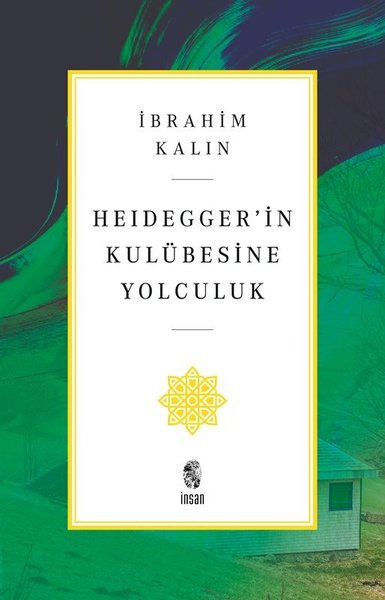
I spent the weekend reading Prof. İbrahim Kalın’s book, Journey to Heidegger’s Hut, a visit in both the literal and philosophical sense, and these are some of my reflections.
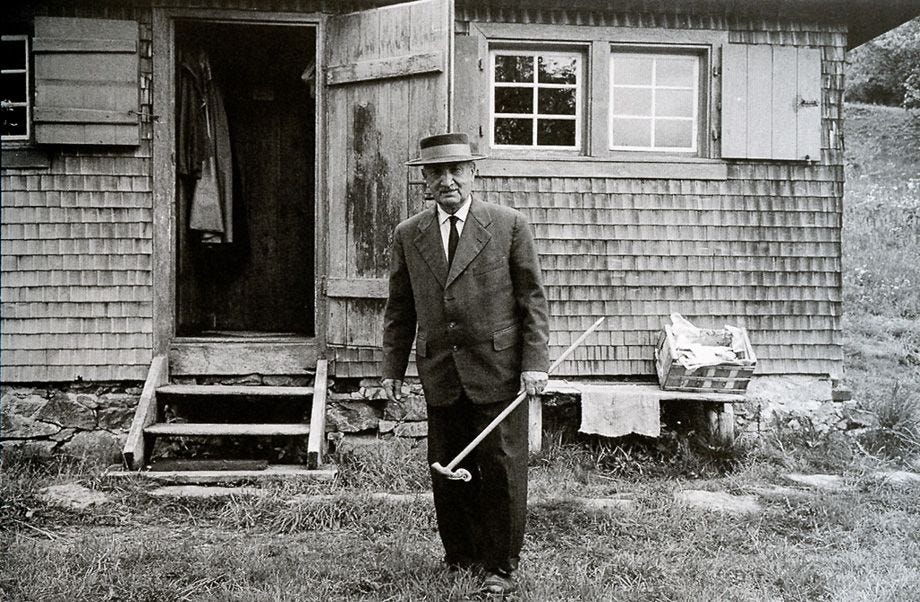
Martin Heidegger’s modest writing desk in his Todtnauberg hut in the Black Forest stands as a profound symbol in 20th-century philosophy. This simple wooden table, overlooking the mountains, was where Heidegger composed much of Being and Time (1927) and later works grappling with the question of Being (Sein). Far from a mere piece of furniture, the desk embodies a space where authentic thinking about Dasein, human existence as “being-there”, becomes possible. In a world increasingly dominated by technological mediation, including generative artificial intelligence, this desk raises urgent questions.
Can we still hold on to the essence of Being? Does a contemporary equivalent exist, a “writing desk” that facilitates authentic handling of existential and practical problems?
These inquiries gain added resonance through İbrahim Kalın’s recent Turkish book Journey to Heidegger’s Hut (2025), which recounts his visit in 2019 to the hut while reflecting on Heidegger’s ontology amid modern crises.
The Space of Authentic Thinking
Heidegger retreated to his hut, built in 1922, to escape the distractions of university life and urban modernity. Here, amid peasant life and natural rhythms, he pursued the forgotten question of Being: not beings (Seiendes), but the meaning of Being itself. The hut’s simplicity, three rooms, a well, no electricity initially, facilitated what Heidegger called “meditative thinking” (besinnliches Denken), as opposed to mere “calculative thinking” (rechnendes Denken). The writing desk, positioned by the window with views of the valley, became the locus of this meditation. In Heidegger’s tool analysis from Being and Time, equipment like a hammer reveals itself authentically when ready-to-hand (zuhanden), withdrawing into the background to disclose a world of meaningful relations. Similarly, the desk, in its unobtrusive presence, enabled Heidegger to confront Dasein’s structures: care (Sorge), thrownness (Geworfenheit), projection (Entwurf), and being-towards-death (Sein zum Tode).
A poignant anecdote underscores the desk’s disclosive power. Heidegger’s younger son, Hermann, reportedly described the workspace in a television program (as paraphrased in Kalın’s book):
When grappling with a difficult problem, sitting at the father’s desk makes “everything become easier” or clearer.
This is no mystical claim but a testament to how the hut’s environment, its silence, rootedness in the earth, and removal from everyday chatter (Gerede), fosters authentic insight. The desk does not solve problems calculatively. It allows the question of Being to emerge, rendering complex ontological issues more accessible. Hermann’s remark highlights how physical space can attune Dasein to its essential possibilities, countering the fallenness into inauthenticity characteristic of “the they” (das Man).
Prof. Kalın’s Visit from the Hut to the Modern Crisis
İbrahim Kalın, a prominent Turkish philosopher and current president of the National Intelligence Organization (MİT), extends this reflection in his 2025 book. Kalın narrates his own journey to Todtnauberg, visiting the preserved hut and sitting at the famous desk. As a Muslim thinker engaged with Western philosophy, Kalın bridges Heidegger’s ontology with Islamic traditions of contemplation and tawhid (unity of Being). His journey is a quest to reclaim the question of Being in an era of homelessness (Heimatlosigkeit). Kalın emphasizes how the hut represents a poetic dwelling (poetisches Wohnen) on the earth, echoing Heidegger’s later essays like “Building Dwelling Thinking” (1951). In a time of geopolitical turmoil and technological acceleration, Kalın asks whether modern individuals, especially those in positions of power, can find analogous spaces to “hold on to the essence.” The situation is the same with intelligence leaders facing complex security dilemmas.
Kalın’s role in Turkish intelligence adds a provocative layer. Intelligence work involves navigating opaque threats, disinformation, and strategic ambiguities, problems demanding both calculative precision and deeper wisdom. Does the “writing desk” metaphor suggest a need for contemplative spaces amid statecraft? Kalın implies yes. Holding on to the Being requires withdrawing from the frenzy of publicness to let truth (aletheia) unconceal itself. In his book, the hut becomes a critique of modernity’s forgetfulness of Being, where humans treat everything, including themselves, as resources. Yet Kalın, positioned at the intersection of philosophy and power, embodies a potential synthesis: a thinker-statesman seeking authentic orientation. His journey poses a direct question: do we hold on to the essence, or do we lack the facilitative “desk” for handling problems authentically?
Technological Enframing and the Forgetting of Dasein
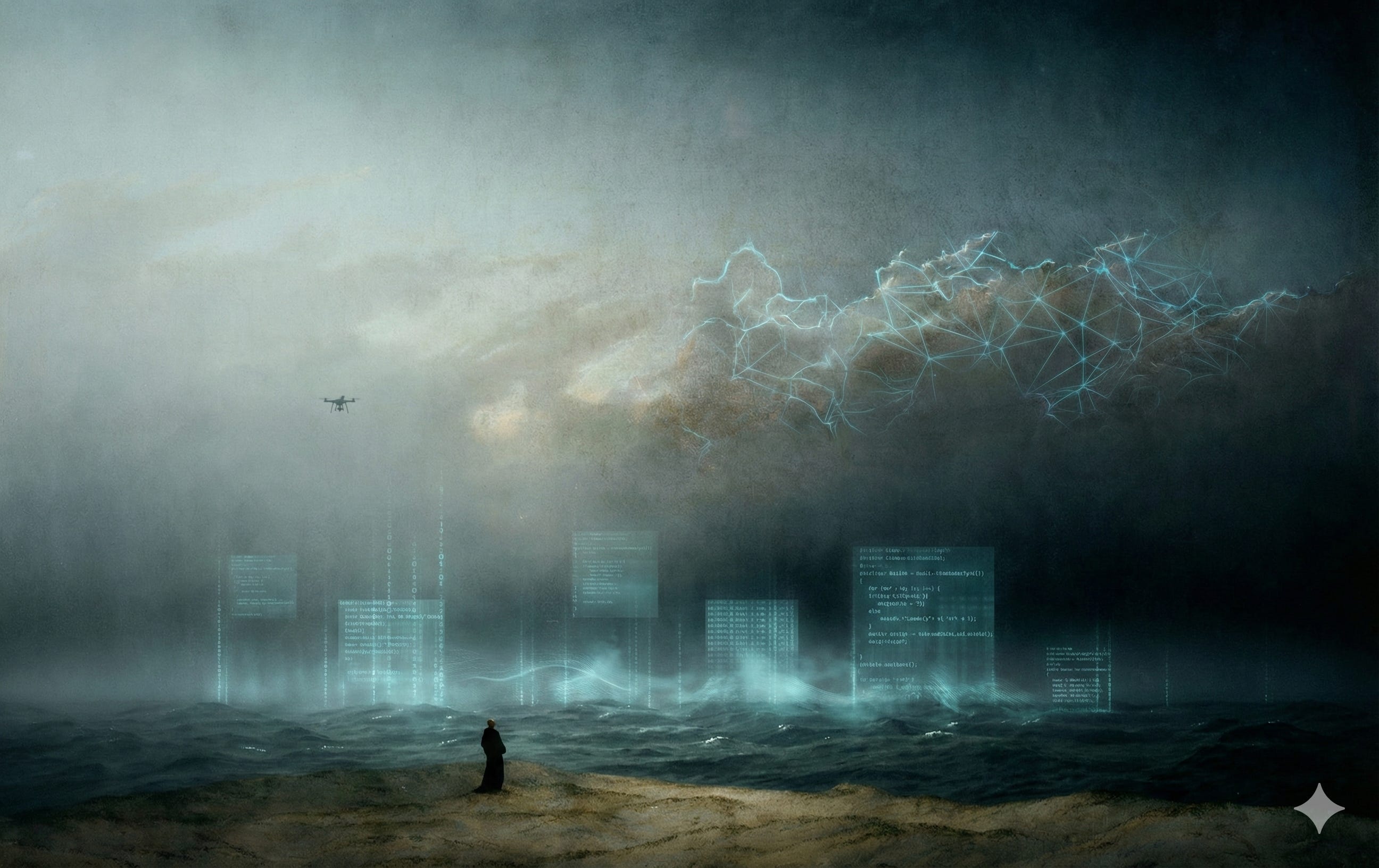
This leads to the contemporary challenge of generative artificial intelligence. What does AI generation mean in terms of Dasein? Heidegger’s critique of technology in “The Question Concerning Technology” (1954) provides a framework. Modern technology is not neutral but a mode of revealing: enframing (Gestell), where nature and humans become “standing-reserve” (Bestand), mere resources ordered for efficiency, unlike ancient techne, which brought forth (her-vor-bringen) in harmony with physis, modern technology challenges forth (her-aus-fordern), concealing other modes of disclosure.
Generative AI exemplifies this enframing par excellence. Models like large language models produce text, images, and code on demand, simulating creativity through statistical prediction. But this generation lacks Dasein’s existential structure. Dasein is finite, temporal, and anxious, disclosed through mood (Stimmung), understanding (Verstehen), and discourse (Rede). AI has no being-towards-death. It is not thrown into a world it cares about. Its “outputs” are average, leveled-down products of das Man, inauthentic chatter amplified infinitely.
Sitting at a digital “desk”, a laptop screen flooded with AI-generated content, does not make “everything become easier” in Heidegger’s sense. Instead, it obfuscates. AI facilitates calculative problem-solving, but at the cost of meditative depth. Problems appear “handled” through optimized solutions, yet the essence, withdrawal of Being, remains forgotten. Generative AI proliferates ready-made interpretations, discouraging the resolute anticipation (vorlaufende Entschlossenheit) needed for authenticity. In terms of Dasein, AI generation means a further falling into inauthenticity. Humans offload projection onto algorithms, treating existence as manipulable data.
Heidegger warned that technology’s danger lies in blocking poetic revealing. Generative AI risks turning language, the house of Being, into a commodified tool. When AI writes philosophy, poetry, or policy briefs, it mimics without dwelling. Kalın’s visit to the physical hut contrasts sharply. There, in simplicity, Being speaks. AI, conversely, enframes even thought as generatable content.

Gelassenheit and Modern Huts
Yet Heidegger saw danger as harboring saving power. If we confront AI as a revealing mode, it might provoke gelassenheit (releasement): letting beings be, thinking non-calculatively. Perhaps in the AI era, holding on to Dasein requires creating modern “huts”, spaces of withdrawal, whether physical retreats or disciplined practices of unplugged reflection. For figures like Kalın, balancing intelligence exigencies with philosophical pursuit models this. The wooden desk reminds us that authentic handling of problems, existential or practical, demands attunement to Being, not mere generation.
Heidegger’s writing desk, illuminated by Hermann’s anecdote and Kalın’s journey, symbolizes the persistent call of Being. Amid AI’s proliferative enframing, we must ask:
Are we holding on to the essence, or surrendering Dasein to standing-reserve?
The hut endures as a provocation to find or build facilitative spaces where everything, once again, becomes clearer. Only thus can we dwell poetically, safeguarding human existence against technological oblivion.
I’m so resisting reading this until I’m done reading the book 🫣