

A few evenings ago, despite a persistent back injury that made me carry my own lumbar pillow into an almost full IMAX theatre, I sat down to watch Christopher Nolan’s The Odyssey, notebook open more out of professional habit than cinematic anticipation. What stayed with me afterwards was not the scale of the set-pieces or the familiar catalogue of monsters, but the quiet, persistent question the film keeps asking of anyone who works with intelligence. How far can judgement reach when the information is incomplete, and the consequences refuse to stay inside the plan?


Nolan’s The Odyssey arrives at a moment when Western culture is once again preoccupied with the foundations of strategic thought. Released in mid-July, the film is not merely another lavish retelling of a familiar myth. In the hands of a director long obsessed with time, perception and the limits of human control, Homer’s epic becomes an unexpected meditation on the nature of intelligence itself. The monsters and the gods remain, yet they serve a larger purpose. The true subject is the intelligence officer’s oldest problem: how to act effectively when information is incomplete, intentions are opaque, and outcomes refuse to obey even the cleverest plan.
What does Odysseus still teach intelligence professionals in the age of artificial intelligence?
Deception as the Oldest Intelligence Technology
The answer begins with deception. From the Trojan Horse to the succession of false identities Odysseus adopts on his return, Nolan organizes the narrative around the deliberate shaping of another’s perception. The wooden horse is not presented as a triumph of engineering but as a calculated violation of the norms of hospitality that held Bronze Age society together. Odysseus understands that force alone cannot breach the walls. The decisive advantage lies in inducing the enemy to open the gates himself. Later, the hero’s disguises, his carefully staged performances of poverty and madness, and his psychological manipulation of those around him continue the same logic. Deception is treated as the oldest intelligence technology. Sun Tzu would have recognized the principle immediately: the supreme art is not to fight but to render the adversary’s strength irrelevant by controlling what he believes.
This insight travels easily into the contemporary world. Strategic deception, denial and deception programmes, cognitive operations and modern information warfare all rest on the same foundation. Intelligence is rarely about brute collection or superior firepower. It is about shaping the decision space of another actor. The difference today is scale and speed. Artificial intelligence now allows influence campaigns to be personalized at the level of the individual, calibrated against behavioral data and delivered through channels that feel intimate rather than propagandistic. Yet the underlying human vulnerability remains unchanged. People still act on what they think they know, and what they think they know can be engineered.
Intelligence Cannot Defeat Uncertainty
Nolan does not, however, allow the audience the comfort of believing that superior intelligence guarantees success. Odysseus is portrayed as a man of extraordinary strategic gifts, adaptive, psychologically acute, capable of long-range planning under extreme pressure. At one point he refuses to accept a prophetic warning that every one of his companions will perish. He insists that skill and foresight can avert the predicted outcome. Events prove him wrong. The companions die. The pattern recurs throughout the film. Brilliant stratagems succeed locally while larger currents of complexity, unintended consequence and sheer contingency sweep the strategist along. The lesson is not that intelligence is useless. It is that intelligence has limits.
This is the heart of the matter for any modern intelligence community. Satellites, signals intelligence, machine learning models, and predictive analytics have expanded the volume of available information beyond anything Odysseus could have imagined. Bounded rationality, however, has not disappeared. Complexity still produces emergent outcomes that no single actor can fully anticipate. Strategic surprise continues to occur. The failure to foresee the rapid collapse of certain regimes, the misreading of adversaries’ risk tolerances, and the persistent underestimation of how information environments reshape political will all demonstrate that more data does not automatically yield clearer judgement. Intelligence reduces uncertainty. It never abolishes it. Nolan’s Odysseus embodies this enduring tension: the most gifted practitioner of intelligence still cannot master fate, contingency, or the secondary effects of his own actions.
The Sirens as a Cognitive Weapon
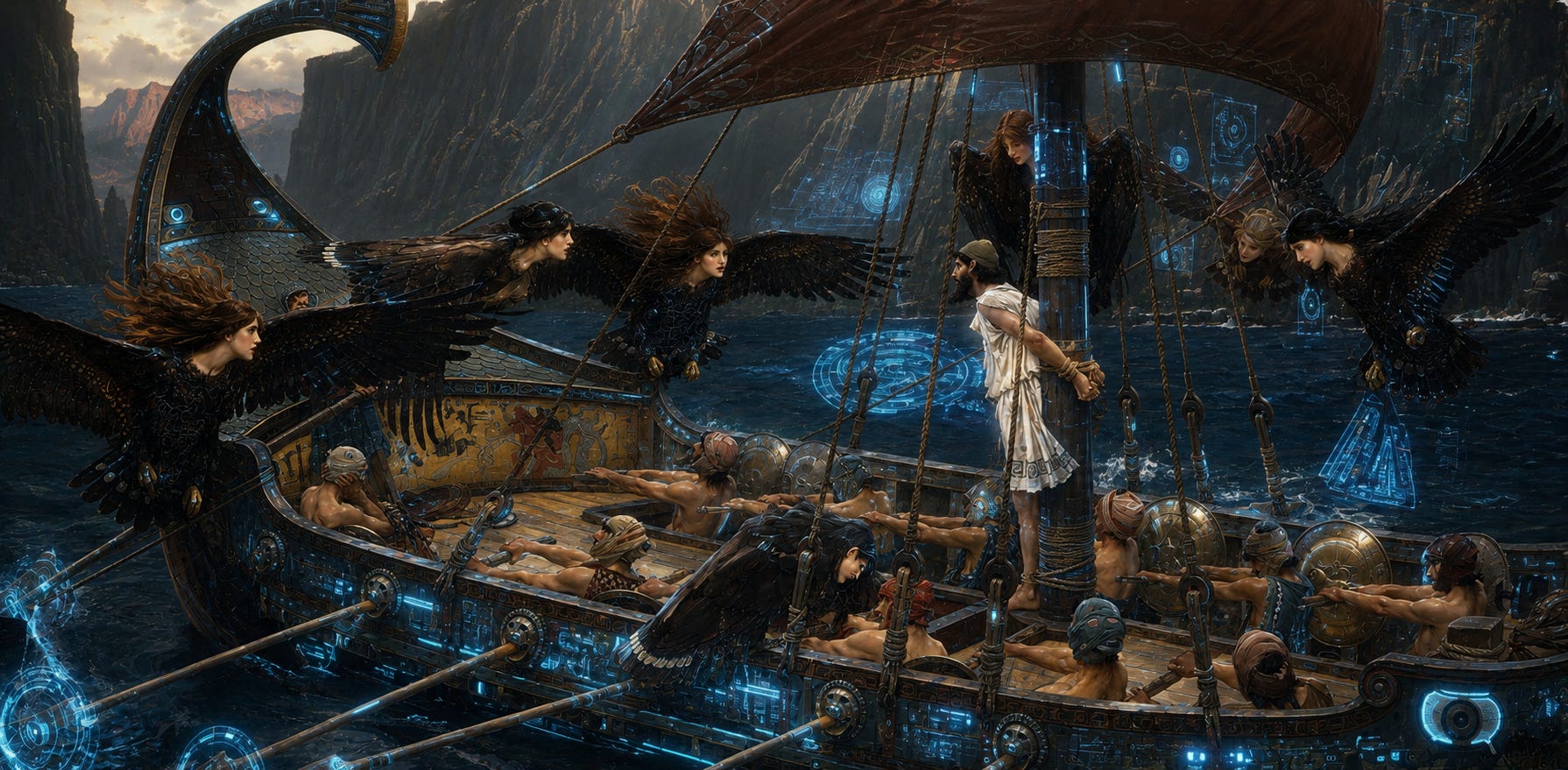
The Sirens sequence sharpens the point further. Nolan refuses to treat the episode as a simple test of physical restraint. Its power is registered only through Odysseus’s reaction and through the language he later uses to describe it. One of the most striking formulations compares the experience to an itch that can never quite be reached. Another moment has Odysseus asking himself whether he truly wishes to return home. The Sirens do not invent desires. They expose and amplify those already present: guilt over broken promises, the seductive possibility of permanent escape from responsibility, the quiet doubt that the longed-for home may no longer exist in the form remembered. These are the real weapons.
The parallel with contemporary cognitive warfare is direct. The most effective forms of behavioral manipulation and personalized persuasion do not create new motivations from nothing. They identify existing emotional and cognitive vulnerabilities and apply pressure precisely there. Recommendation algorithms, targeted information operations, and AI systems capable of modelling individual psychological profiles operate on the same principle. The greatest danger is not external coercion. It is the exploitation of desires the target already harbours. Odysseus’s struggle with the Sirens is therefore less a heroic ordeal than a study in the fragility of the human decision-maker under conditions of sophisticated psychological assault.
Penelope’s parallel campaign of deception on Ithaca completes the picture. Night after night she unravels the funeral shroud she weaves by day, postponing the moment when she must choose among the suitors. The ruse is eventually exposed when the maidservant Melantho informs on her. One of the leading suitors, Antinous, then explicitly accuses Penelope of deception. The detail is small yet decisive. Every deception creates incentives for counter-intelligence. Every covert operation depends upon the loyalty, or the silence, of those who know its secrets. Intelligence networks, formal and informal, exist wherever interests diverge and information confers advantage. Insider threats, betrayal and the leakage of carefully guarded knowledge are not modern pathologies. They are structural features of human organization. Technology can encrypt messages and obscure digital footprints, but the fundamental social character of intelligence remains. Collection systems, however sophisticated, still rest on human agents, human sources and human judgements about reliability.
Assessment Before Action
One of the more understated but revealing choices in Nolan’s screenplay is the repeated use of the word “assess.” Agamemnon advises Odysseus not simply to return in triumph but first to assess the situation that awaits him. The linguistic precision is significant. Modern intelligence practice distinguishes carefully between information, analysis, assessment, evaluation, foresight and warning. These are not interchangeable terms. Assessment is the act of forming a judgement under conditions of incomplete knowledge and competing interpretations. It is the point at which raw data and analytical products are converted into something actionable yet still provisional. Even in an era of large language models and decision-support systems, assessment remains the most intellectually demanding product of the intelligence cycle. Algorithms can surface patterns and generate probabilities. They cannot yet replace the human capacity to weigh qualitative factors, to sense when models are drifting from reality, or to decide how much residual uncertainty is tolerable before action must be taken.
Other elements of the film reinforce the same themes without requiring elaborate exposition. Calypso’s observation that Odysseus will awaken only when he is ready invites a psychological rather than a purely mythological reading. After seven years she concludes that the moment has arrived. Readiness, the film suggests, is not a function of chronological time but of identity. The strategist must recover a coherent sense of purpose before strategic action becomes possible again. The extraordinary loyalty of the dog Argos, who has waited twenty years, functions symbolically rather than as a claim of biological realism. In a world where prophecy, omens and divination competed with systematic observation, the tension between evidence-based judgement and other forms of belief was already present. Even the brief references to those who sought to avoid military service by hiding their sons or manipulating mobilization systems remind us that intelligence has always operated inside societies shaped by incentives, fear and calculation.
A balanced evaluation is necessary. Nolan succeeds in portraying intelligence as a fundamentally psychological and social activity rather than a purely military or technological one. The emphasis on deception, perception management and the limits of foresight is sophisticated. At the same time, the film’s focus on individual genius occasionally underplays the institutional dimensions of intelligence such as the networks of collection, the processes of organizational learning, the cumulative refinement of tradecraft across generations. Some classicists have noted that Nolan simplifies Homer’s moral ambiguity and reduces certain political and divine dimensions of the original. These criticisms have force. They do not, however, diminish the film’s value as a prompt for thinking about intelligence. On the contrary, they clarify where cinematic compression ends and the harder questions of professional practice begin.
Today’s intelligence agencies increasingly rely on machine learning, large language models, predictive analytics, decision-support systems and autonomous sensing. These tools expand the volume, velocity and variety of information available to decision-makers. None of them abolish uncertainty. Odysseus remains relevant because he reminds us that intelligence is ultimately a profoundly human activity. Technology can expand perception. It cannot eliminate ambiguity. The decisive advantage rarely belongs to the actor who possesses the greatest quantity of information. It belongs to the actor capable of exercising the soundest judgement under conditions of irreducible uncertainty. That lesson is as old as the journey from Troy to Ithaca, and as current as the next intelligence assessment that must be written before the full picture is known.