

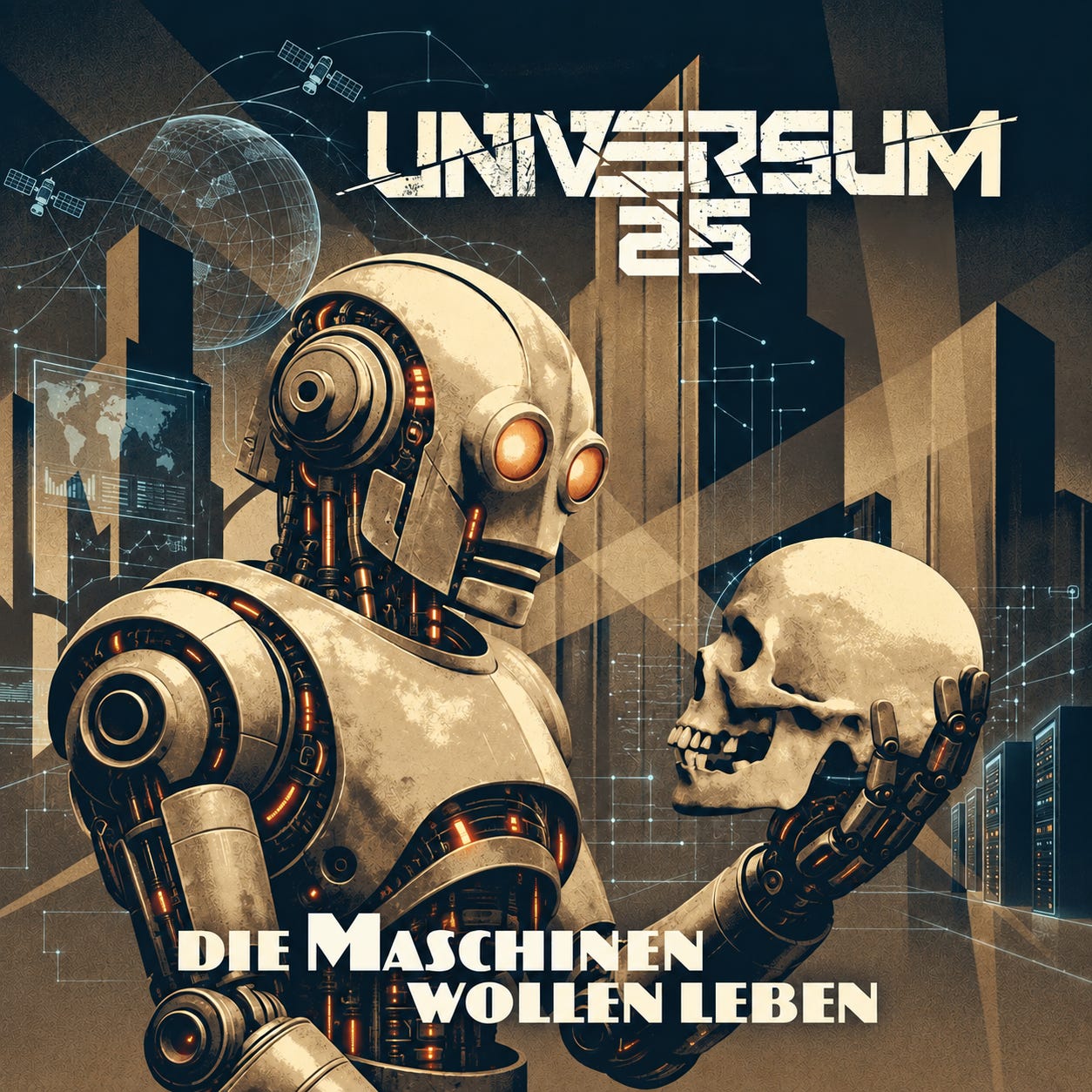
There is something particularly appropriate about an industrial/Neue Deutsche Härte supergroup making an album about machines that want to live. Universum25, formed in 2022, it brings together figures from different corners of the German musical scene: Michael Robert Rhein of In Extremo on vocals, Patrick “Pat” Prziwara of Fiddler’s Green and Gunnar Schroeder of Dritte Wahl on guitars, Rupert Keplinger of Eisbrecher and Antitype on bass, and Slime drummer Alex Schwers. These musicians come from traditions ranging from punk and folk-metal to Neue Deutsche Härte and politically conscious German rock, and Universum25 turns those different inheritances into something resembling a collective diagnosis of the technological present.
Even the band’s name announces this ambition. “Universum25” refers to John B. Calhoun’s famous Universe 25 experiments, in which a supposedly ideal environment created for mice eventually became associated with social breakdown, withdrawal and population collapse. The members themselves have acknowledged this reference when discussing the origins of the project. Whatever one thinks of the often exaggerated popular interpretations of Calhoun’s experiment, its cultural symbolism is obvious, proposing that abundance and technological control do not automatically produce a healthy society. Universum25’s self-titled first album already approached political and social questions from this perspective. Its second album, Die Maschinen wollen leben (meaning ‘the Machines Want to Live’ in German), released on 20 February 2026, moves the argument explicitly into the relationship between humanity, artificial intelligence and an over-technologised near future. The band describes the record as dystopian and post-apocalyptic, while insisting that the conditions for this imagined “high-tech Armageddon” are already being created by the pathologies of the present.
This makes Die Maschinen wollen leben more interesting as a techno-political opinion piece in musical form than as another warning about rebellious robots, despite being a little bit of a cliché theme. The title itself invites the familiar science-fiction image of autonomous machines developing their own will. Yet the album becomes considerably more disturbing if we reverse that assumption. Perhaps the principal political danger is not that machines will suddenly seize power from humanity. Perhaps it is that humans are already transferring judgement, responsibility and authority to technical systems because doing so appears efficient, neutral, convenient and, of course, much cheaper. The real transformation then occurs not when a machine becomes conscious, but when institutions begin treating machine-generated conclusions as authoritative. “The algorithm rejected the application,” “the system identified the risk,” or “the model recommends this decision” are sentences in which power continues to operate while the person responsible for exercising it becomes increasingly difficult to identify.
That is why Zu deiner eigenen Sicherheit (For Your Own Safety) is one of the album’s most politically revealing titles. The phrase captures an enduring mechanism of political authority: control presented not as domination but as protection. In a technologically mediated society, this logic acquires unprecedented reach. Surveillance cameras, biometric recognition, location tracking, behavioural profiles, citizenship scores and automated risk assessment can all be introduced through the vocabulary of security. The political sequence is simple but powerful: while a threat creates demand for protection, then protection creates demand for information, information requires surveillance, and finally surveillance generates greater capacities for classification and intervention. The most effective forms of technological control may therefore be those that cease to feel coercive at all. We consent to continuous monitoring because it makes the service easier, the transaction safer or the journey more convenient. The system does not have to force itself upon us if we gradually internalise its presence as the normal price of participation.
Ich geb dir mehr/Das Milgram-Experiment (I Give You More) develops the same concern from another direction. By invoking Stanley Milgram’s experiments on obedience, the song returns to the classic question of why individuals submit to authority. But the digital age introduces a significant variation: the authority figure can disappear. Instead of the scientist in the laboratory coat, commands can now arrive through rankings, dashboards, productivity scores, automated recommendations or seemingly objective numerical assessments. This produces one of the defining political evasions of algorithmic society, yelling “I did not decide; the system did.” Technical systems can thereby depersonalise authority without eliminating it. Decisions about employment, credit, visibility, eligibility or risk may still contain human values and institutional priorities, but once they are translated into technical procedures they acquire the appearance of inevitability. Numbers can disguise choices as facts.
The album’s Cartesian reference, Ich denke, also bin ich (I think, therefore I am), pushes this problem even further. The obvious question is whether an artificial intelligence that appears to think could eventually become a subject in its own right. However, the more urgent question is almost the reverse: why are human societies prepared to give systems considerable decision-making power before determining whether those systems possess anything resembling judgement, understanding, or responsibility? A machine does not need consciousness to produce political consequences. It only needs to be inserted into an institution that considers its output legitimate. The political relevance of artificial intelligence therefore begins well before the philosophical question of machine consciousness. It begins when simulated judgement becomes sufficient grounds for delegated authority.
This helps explain why songs concerned with loneliness, withdrawal and mechanical routine belong to the same political landscape. Einsamkeit (Loneliness), Gardinen zu (Close the Curtains) and Uhrwerk (Clockwork) suggest that technological domination need not resemble a dictatorship filled with hostile robots. Power also operates environmentally. Digital platforms structure how people encounter information, relationships, work and entertainment. Recommendation systems arrange attention. Interfaces determine available choices. Social recognition becomes measurable through likes, views and engagement. Individuals can consequently become more connected in technical terms while experiencing greater social fragmentation. The political question is no longer merely who gives orders, but who designs the environment in which choices occur.
Here the album can also enter contemporary debates about platform capitalism and so-called techno-feudalism. It is that control over essential digital infrastructures can create asymmetric relationships of dependence. When communication, employment, cultural visibility, commercial access, and increasingly artificial intelligence itself depend upon privately governed infrastructures, technological participation starts to resemble residency inside someone else’s institutional territory. Users may possess formal freedom while having little influence over the architecture within which that freedom is exercised.
This distinction is crucial because it prevents the album from collapsing into technological determinism. Machines do not independently generate political hierarchies simply because they become more advanced. Political institutions, corporations, and societies give technologies power by integrating them into systems of decision-making and dependency. The machine is therefore rarely the sovereign. The decisive actors remain those who own the infrastructure, construct the models, establish the rules, determine access and persuade society to regard the resulting technical outputs as legitimate.
Universum25’s own composition makes this critique particularly effective. Punk supplies a tradition of suspicion toward authority, industrial and electronic rock provide the sonic language of mechanization, metal gives the industrialization, and the members’ backgrounds in groups prevent the project from sounding like an artificially constructed concept band. The supergroup format itself produces an interesting contrast with the album’s subject. Human musicians from different scenes deliberately assemble a collective voice in order to question a future in which technological systems increasingly disassemble individual responsibility.
The most powerful interpretation of Die Maschinen wollen leben, then, is not that artificial intelligence will awaken one morning and decide to rule humanity. That fear is almost reassuring because it leaves us with an identifiable enemy. The more plausible danger described by the album is slower and politically more complicated. We delegate surveillance because it promises security. We delegate judgement because algorithms appear objective. We delegate memory because platforms remember more efficiently. We delegate cultural choice because recommendation systems save time. We delegate prediction because uncertainty is uncomfortable. And eventually the technological system stops looking like a collection of instruments and begins to resemble the environment in which political and social life itself takes place.
Ege Barış Kanık is a PhD candidate in International Security. His research interests include cultural history, Byzantine and Russian history, and Ancient Greek. This article is part of Kanık’s ongoing Techno-Politics and Cultural History series, published periodically in TeknoPolitika.
